AI SaaS Development

AI SaaS development where the unit economics are designed, not discovered

Our AI SaaS development work combines model capabilities with tenant isolation, usage metering and cost controls. We design around the product’s workflow and unit economics before adding features at scale.

Free 30-minute consultation
Fixed-scope pilots
U.S.-based team
Custom, not off-the-shelf
SOC 2-aligned practices
ROI tracked in writing
What is AI SaaS development?

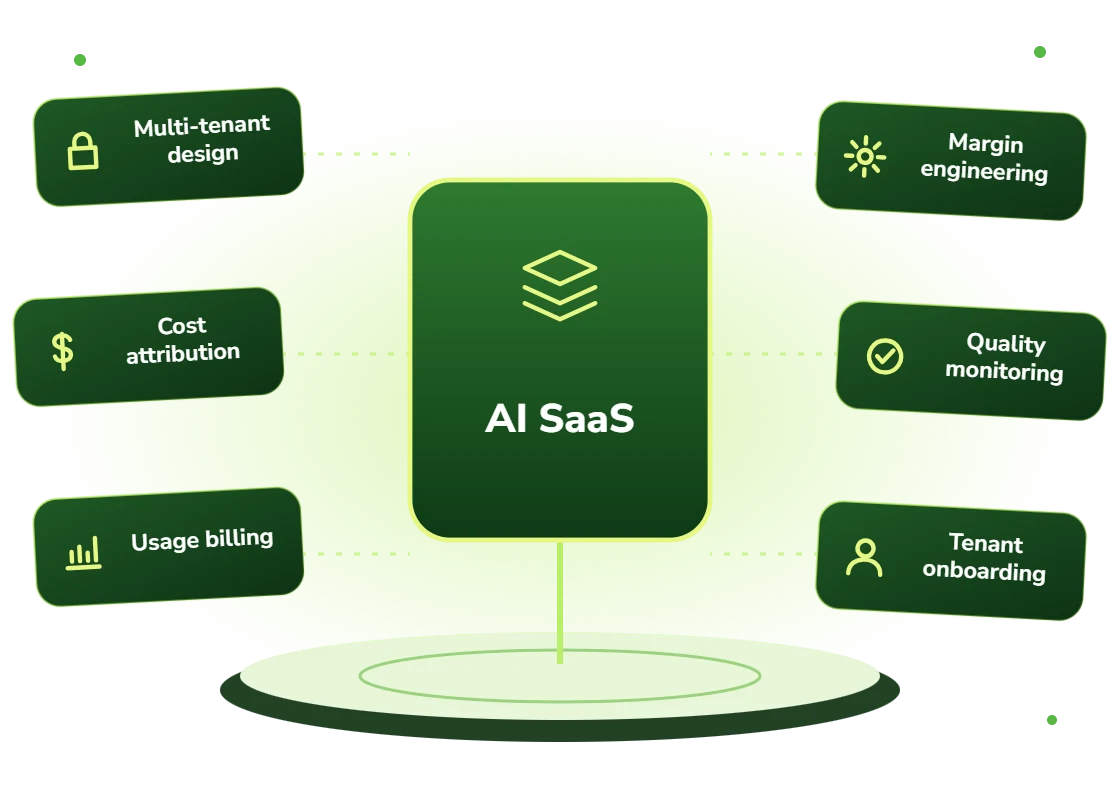
AI SaaS development is building multi-tenant software products with AI capabilities delivered as a subscription service. It requires everything conventional SaaS needs, tenancy isolation, billing, provisioning, plus AI-specific concerns: per-tenant cost attribution, usage metering, model routing to protect margin, and quality monitoring across heterogeneous customer data.

7+
Years building AI systems
240+
Projects delivered
4.8
Avg. months to payback
38
U.S. states served
The Problem

The AI SaaS that loses money on its best customers

Conventional SaaS has near-zero marginal cost per user, which is why flat-rate pricing works. AI SaaS does not: every request costs real money, and the heaviest users can cost more than they pay.

Companies discover this after launch, when the cloud bill arrives and someone works out that the top 5% of accounts consume 60% of inference spend on the same flat subscription.

Our Approach

Cost attribution before pricing, not after

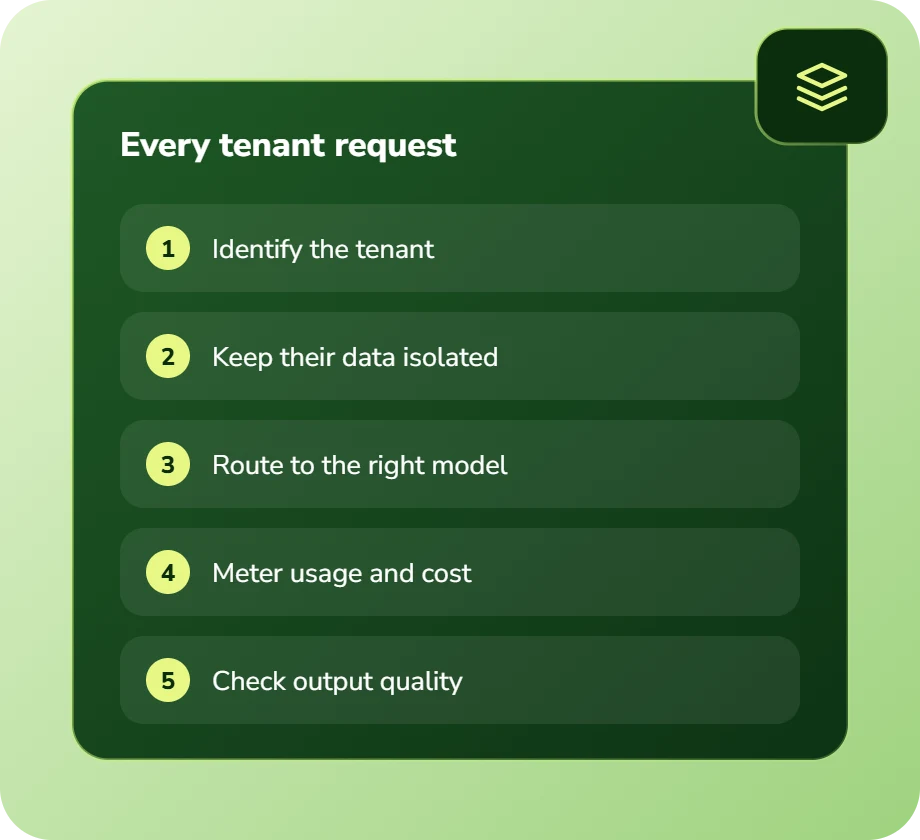
We instrument per-tenant cost from the first line of code, so you know what each customer actually costs to serve while there is still time to price accordingly.

Then we engineer the margin: semantic caching, routing simple requests to cheap models, and usage limits that are enforced by architecture rather than by hoping customers are reasonable.

Cloud illustration
Conceptual cloud illustration
Service Overview

AI SaaS development: scope and deliverables

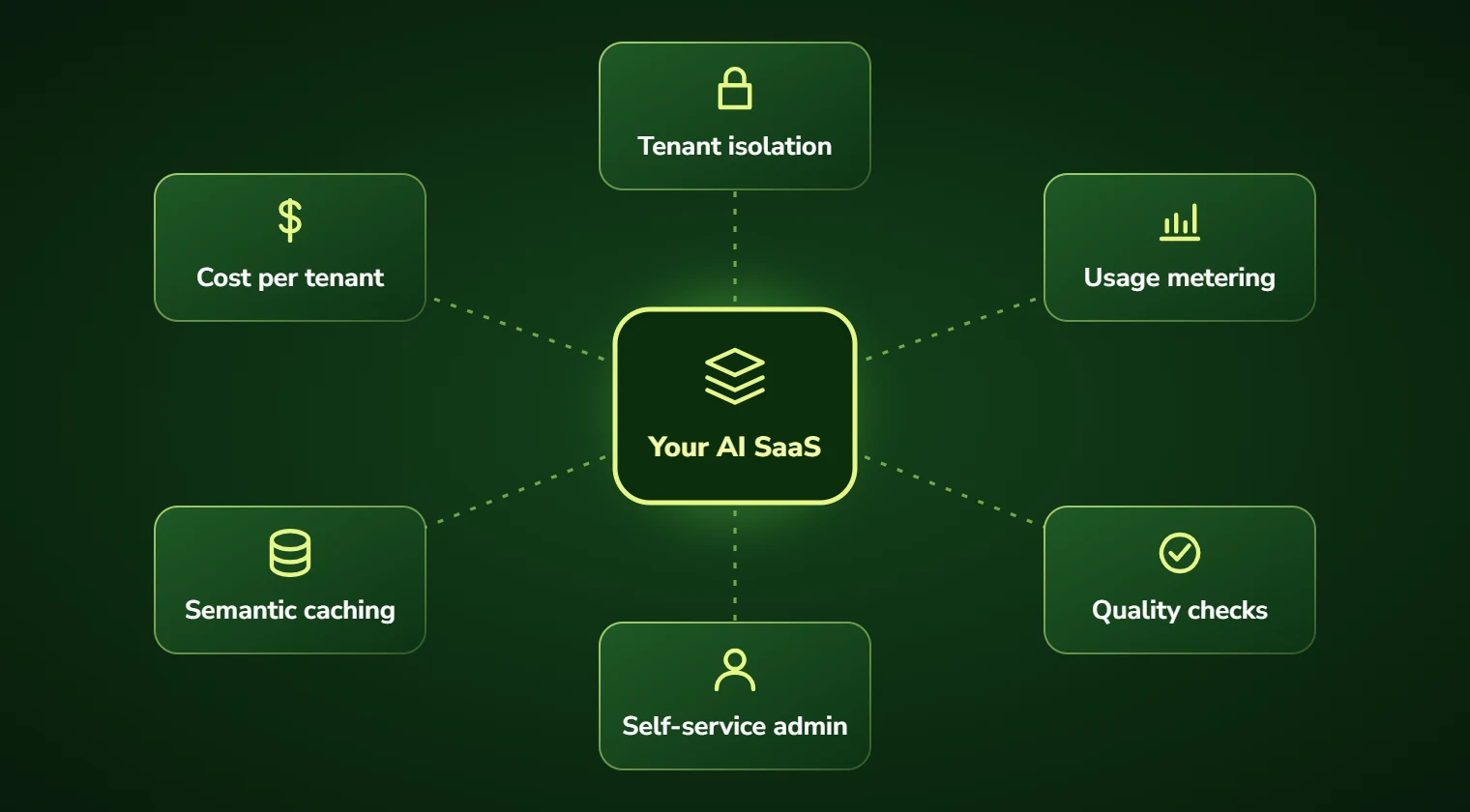
Multi-tenancy is the foundation, and AI makes it harder than usual. Beyond database isolation, you need to guarantee that one tenant’s data cannot appear in another’s model context, a failure mode conventional SaaS does not have.

Then metering and cost attribution: knowing per tenant, per feature, what inference actually cost. Without it, pricing is guesswork and gross margin is unknowable.

Then the margin engineering itself: caching, model routing, prompt efficiency and rate limiting. On a typical AI SaaS these determine whether the business works, and they are far cheaper to design in than to retrofit.

  • Multi-tenant architecture with data and context isolation guarantees
  • Per-tenant, per-feature cost attribution from day one
  • Usage metering feeding billing, limits and customer-facing dashboards
  • Margin engineering: semantic caching, model routing, prompt efficiency
  • Quality monitoring across heterogeneous tenant data
  • Provisioning, onboarding and self-service tenant administration
Right Fit

Who this is for

Software companies adding AI to an existing product, where the question is how to do it without destroying the gross margin the business is valued on.

And startups building AI-native products, where the architecture decisions made in the first three months determine whether the unit economics can ever work.

  • SaaS companies adding AI features to an existing subscription product
  • Startups building AI-native platforms sold to multiple customers
  • Companies whose AI feature launched and whose margin is now under pressure
  • Platforms needing per-customer usage limits and billing
  • Products serving regulated customers requiring tenancy isolation guarantees
  • Teams needing per-tenant cost data to set or revise pricing
Benefits

Benefits of AI SaaS development

Margin you can see

Per-tenant cost attribution means gross margin is a number you monitor rather than a quarterly surprise.

Pricing based on evidence

Real cost-to-serve data before you commit to a pricing model, rather than after customers are on it.

Isolation you can prove

Tenancy separation at the data and context layer, documented well enough to survive a customer security review.

Heavy users that stay profitable

Caching, routing and enforced limits so the top percentile of usage does not erase the margin from everyone else.

Quality monitored per tenant

Degradation on one customer’s unusual data detected before that customer reports it.

Scales without re-architecture

Provisioning, metering and isolation built for many tenants from the start rather than bolted on at fifty.

Problems We Solve

Business challenges this solves

01

Unknown cost to serve

No per-customer cost data. Attribution from day one makes pricing and margin decisions evidence-based.

02

Power users destroying margin

A small share of accounts consuming most inference. Caching, routing and limits contain it.

03

Tenancy isolation under scrutiny

Enterprise buyers demanding proof data cannot cross tenants. Isolation designed and documented for review.

04

Flat pricing on variable cost

Subscription revenue against per-request cost. Metering enables usage-aware pricing that still feels simple.

05

Quality varying by customer

Output good for some tenants and poor for others with unusual data. Per-tenant monitoring surfaces it.

06

Onboarding that needs an engineer

Manual provisioning limiting growth. Self-service tenant setup removes the bottleneck.

What's Included

Features and deliverables

Everything below is in scope on a standard engagement. Nothing here is an upsell discovered halfway through the build.

01

Multi-tenant architecture

Tenant isolation at data, storage and model-context layers, with the design documented for customer security reviews.

02

Cost attribution engine

Token and inference cost tracked per tenant, per feature and per request, surfaced in internal dashboards.

03

Usage metering and limits

Metering feeding billing, plan entitlements, soft warnings and hard caps enforced in the request path.

04

Semantic caching

Similar requests served from cache rather than re-inferred, typically one of the largest single margin improvements available.

05

Model routing

Requests routed by complexity so simple tasks use small cheap models and only hard ones reach frontier models.

06

Per-tenant quality monitoring

Output quality scored per tenant so degradation on unusual data is caught before a customer notices.

07

Self-service provisioning

Tenant creation, configuration, user management and plan changes without engineering involvement.

08

Compliance tooling

Per-tenant data residency options, retention policies, audit logs and export for customer compliance requirements.

Technology Stack

Technologies we use for AI SaaS development

We are not tied to one vendor. Model and infrastructure choices are made on accuracy, cost per task, latency, and where your data is allowed to live.

Language Models
C
Claude (Anthropic)
G
GPT (OpenAI)
G
Gemini (Google)
L
Llama
M
Mistral
A
Azure OpenAI Service
Agent & Orchestration
M
Model Context Protocol
L
LangGraph
L
LangChain
L
LlamaIndex
T
Temporal
C
Celery
Vector & Retrieval
P
Pinecone
W
Weaviate
Q
Qdrant
p
pgvector
E
Elasticsearch
A
Amazon OpenSearch
Data & Backend
P
Python
T
TypeScript / Node.js
P
PostgreSQL
S
Snowflake
d
dbt
A
Apache Airflow
Cloud & Infrastructure
A
AWS Bedrock
G
Google Vertex AI
M
Microsoft Azure
D
Docker
K
Kubernetes
T
Terraform
How We Work

Our AI development process

The same five stages on every engagement, so you always know what happens next and what you get at the end of it.

01

Discovery

We interview the people doing the work, map the workflow end to end, and audit the systems and data behind it.

02

AI Strategy

Every opportunity gets scored on cost to build, time to value, and annual savings, then ranked.

03

Pilot Build

We ship the top-ranked automation as a fixed-scope pilot so you see real output before committing further budget.

04

Implementation

Integration with your live systems, staff training, human-in-the-loop review gates, and a documented rollback path.

05

Optimization

Monthly accuracy reviews, prompt and retrieval tuning, and a written report on hours and dollars saved.

Timeline

How long it takes

A typical first engagement, week by week. Complex integrations and regulated environments extend this, and we say so during discovery rather than after.

Weeks 1 to 3

Architecture and economics

Tenancy model, cost projection at scale, pricing implications and a fixed-price build plan.

Weeks 4 to 8

Platform foundations

Multi-tenancy, auth, metering, cost attribution and the AI integration layer.

Weeks 9 to 14

Product features

Customer-facing AI capability built on the platform, with fortnightly demos.

Weeks 15 to 18

Margin and hardening

Caching, model routing, load testing, security review and per-tenant quality monitoring.

Weeks 19 to 20

Launch and enablement

Staged rollout, runbooks, engineer enablement and 30 days of included support.

Who We Work With

Industries we deliver AI SaaS development for

SaaS & Technology

AI features inside your product, support deflection, onboarding assistants, and usage analytics.

Financial Services

Document extraction, reconciliation, KYC support, and audit-ready reporting with full traceability.

Healthcare

Intake, prior authorization, clinical documentation, and revenue-cycle workflows built to respect HIPAA boundaries.

Professional Services

Proposal drafting, timesheet capture, research synthesis, and client reporting at scale.

Legal

Contract review, discovery triage, and matter intake with citation-checked outputs and attorney sign-off gates.

Retail & E-commerce

Product data enrichment, demand forecasting, support deflection, and personalized merchandising.

Insurance

First-notice-of-loss intake, claims triage, policy Q&A, and fraud signal detection.

Education

Enrollment support, content generation, tutoring assistants, and administrative automation.

Use Cases

Real-world use cases

01

AI features in an existing SaaS

Adding AI capability to a mature product without undermining the gross margin it is valued on.

02

Vertical AI platforms

Industry-specific AI products serving many customers with shared logic and per-tenant data.

03

AI-powered analytics products

Natural-language querying over each customer’s own data with strict cross-tenant isolation.

04

Document processing platforms

Multi-tenant extraction services with per-customer models, volume metering and usage billing.

05

Embedded AI for partners

White-labelled AI capability offered to partners under their own brand with usage attribution.

06

Regulated-industry AI SaaS

Products serving healthcare or financial customers who require documented isolation and residency controls.

Why DevSolutionsAI

Why choose DevSolutionsAI for AI SaaS development

Business case before build

Every recommendation carries an estimated cost, timeline, and annual savings figure. If the math does not work, we say so before you spend.

Vendor-neutral by design

We resell nothing and take no platform commissions. Model and infrastructure choices are made on fit, cost, and your data-residency rules.

Fixed-scope pilots

The first engagement is a defined deliverable at a defined price, not an open-ended retainer that quietly grows each quarter.

Built for handover

You own the code, the prompts, the infrastructure, and the documentation. No lock-in to a proprietary wrapper you cannot leave.

Human-in-the-loop where it counts

Anything customer-facing, clinical, financial, or legal gets a review gate, a confidence threshold, and a logged audit trail.

Security reviewed early

Data flow diagrams, retention rules, and access boundaries are agreed in week one, not retrofitted after your security team objects.

Get Started

Find out what AI SaaS development would cost you, before you commit to anything

Every engagement is quoted after a short discovery, so you get a fixed written price built around your actual volumes rather than a rate card that assumes someone else’s business.

The first call is thirty minutes and free. Bring one workflow. We will tell you what it is likely costing you each year, roughly what automating it would take, and whether we think it is worth doing at all.

  • A written savings estimate before any paid work
  • Fixed scope and fixed price, agreed up front
  • Full ownership of everything we build for you
  • An honest recommendation when the numbers do not work
What clients typically see
Across recent projects
Staff hours saved each week
31
Months to payback
4.8
Client retention
94%
Response to enquiries
4 hrs

Figures are internal measurements across recent engagements, reported to every client monthly in writing.

Illustrative project scenario

Illustrative project scenario

Vertical SaaS · 900 business customers

Turning a negative-margin AI feature into a 71% gross margin

Challenge. A vertical SaaS company launched an AI feature across its base on a flat subscription. Within four months the inference bill exceeded the incremental revenue. Analysis was impossible because usage was not attributed per customer, so nobody knew which accounts drove the cost.

What we built. Per-tenant cost attribution instrumented first, which revealed 7% of customers generated 64% of inference spend. We then implemented semantic caching for repeated queries, routing of simple requests to a smaller model, and plan-based usage entitlements with soft warnings before hard caps.

Outcome. Gross margin on the AI feature moved from negative to 71%. Caching alone absorbed roughly a third of request volume. Two heavy accounts moved to a usage-based enterprise plan, which they accepted once shown their own consumption data.

Negative → 71%
AI feature gross margin
7% / 64%
Customers driving spend
~33%
Requests served from cache
0
Customers churned on limits

Illustrative project scenario. The figures demonstrate how a project could be scoped and evaluated; they are not verified client results or an audited average.

Client Feedback

What clients say about working with us

31
Avg. staff hours saved weekly
4.8
Avg. months to payback
94%
Client retention
4
Hour response to enquiries
Common Questions

AI SaaS Development FAQs

Conventional SaaS has near-zero marginal cost per user, which is why flat-rate pricing works and why the sector is valued the way it is. AI inference costs real money on every request, so a flat subscription against variable cost means your heaviest users can cost more than they pay. Without per-tenant cost attribution, companies typically discover this several months after launch, when the pricing is already in market.

Three mechanisms, in rough order of impact. Semantic caching serves similar requests from cache rather than re-inferring, which on a typical product absorbs a substantial share of volume. Model routing sends simple requests to small cheap models and reserves frontier models for genuinely hard ones. And plan-based usage entitlements enforce limits in the request path rather than relying on customers being reasonable.

Isolation at three layers: database or schema separation, storage separation including vector indexes, and enforced tenant scoping on every model call so retrieved context can only come from that tenant. We document the design specifically for customer security reviews, because enterprise buyers of AI products increasingly ask this and a vague answer loses deals.

It depends on how central AI is. If it is a secondary feature that a minority of users touch occasionally, a bolt-on is proportionate and much faster. If AI is core to the value proposition and will drive a meaningful share of your cost base, the platform investment pays for itself in margin control. The two-to-three week economics engagement is designed to answer this before you commit.

Eighteen to twenty weeks for a production multi-tenant platform, following three weeks of architecture and economics work. We build platform foundations, tenancy, metering, cost attribution, before product features, because retrofitting attribution onto a live product is considerably harder than building it in.

Yes, and for product companies this is the most common arrangement. Typically we build the AI platform layer, tenancy, metering, routing, caching, monitoring, while your team builds product features on top of it. Enablement runs throughout so your engineers own the platform by the end rather than depending on us.
Service Areas

AI SaaS Development across the United States

We deliver AI saas development remotely to clients nationwide, with on-site workshops available in major metros.

Ready to scope your AI SaaS development project?

Book a free 30-minute consultation. Bring one workflow and leave with a realistic estimate of what it would cost to automate and what it would save.

Free 30-minute consultation
Fixed-scope pilots
U.S.-based team
Custom, not off-the-shelf
SOC 2-aligned practices
ROI tracked in writing
Free 30-minute AI consultation