AI API development for connected applications
Our AI API development work makes model capabilities available to other applications. We add versioning, authentication, rate limits, caching and monitoring so teams can manage reliability and usage costs.
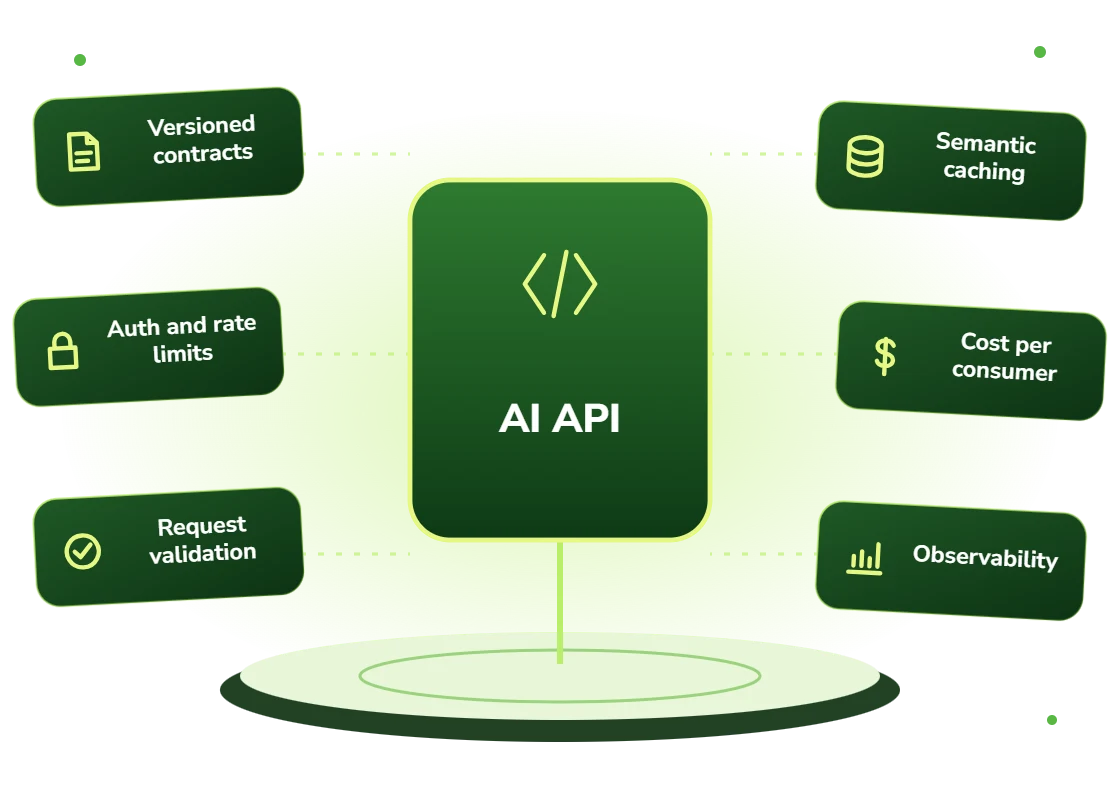
AI API development is the building of production-grade programmatic interfaces that expose AI capability to other applications, internal teams or external partners. Beyond calling a model, it covers authentication, rate limiting, versioning, caching, cost attribution, error handling, observability and the contract guarantees that let other systems depend on the endpoint.
The internal endpoint everyone depends on and nobody owns
It starts as one team wrapping a model call for their own use. Then another team finds it, then a third. Within a year six systems depend on an endpoint with no versioning, no rate limiting and no owner.
The first outage reveals the situation: no timeouts, no fallback, no idea who is calling it or what they will do when it fails.
Treat AI capability as a real service
We build AI endpoints the way any service other teams depend on should be built: versioned contracts, authentication and per-key rate limits, documented error semantics, and observability that attributes usage and cost to callers.
That means a consuming team can integrate confidently, and you can change the model underneath without breaking six downstream systems.
AI API development: scope and deliverables
The contract comes first. A stable, versioned interface means the implementation behind it can change, a different model, a different prompt, an added caching layer, without coordinating a release across every consumer.
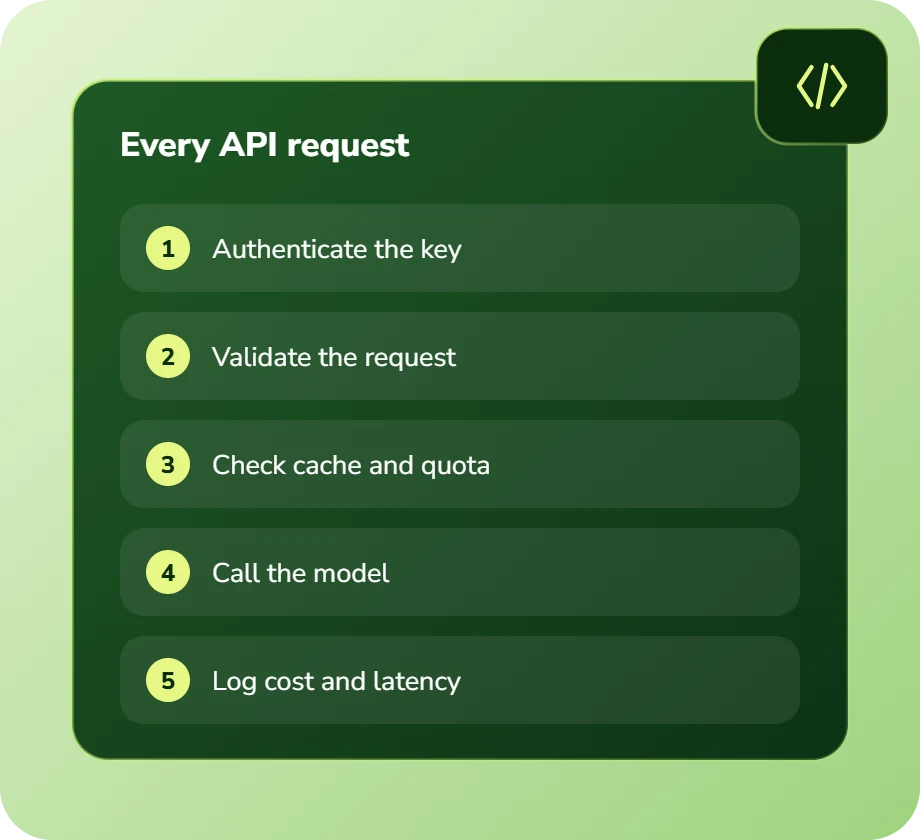
Then the operational layer: authentication, per-key rate limits and quotas, request validation, structured errors, timeouts and retries with sensible backoff, and graceful degradation when an upstream provider is slow.
And the governance layer: cost attributed per key so you know which consumer drives spend, quality monitoring so degradation is caught centrally rather than reported by whichever team notices first.
- Versioned API contracts with documented deprecation policy
- Authentication, per-key rate limiting and quota enforcement
- Request validation, structured error responses and clear semantics
- Response caching, including semantic caching for similar requests
- Cost attribution per consumer, with budgets and alerting
- Observability: tracing, latency percentiles, error rates, quality metrics
When you need a real AI API
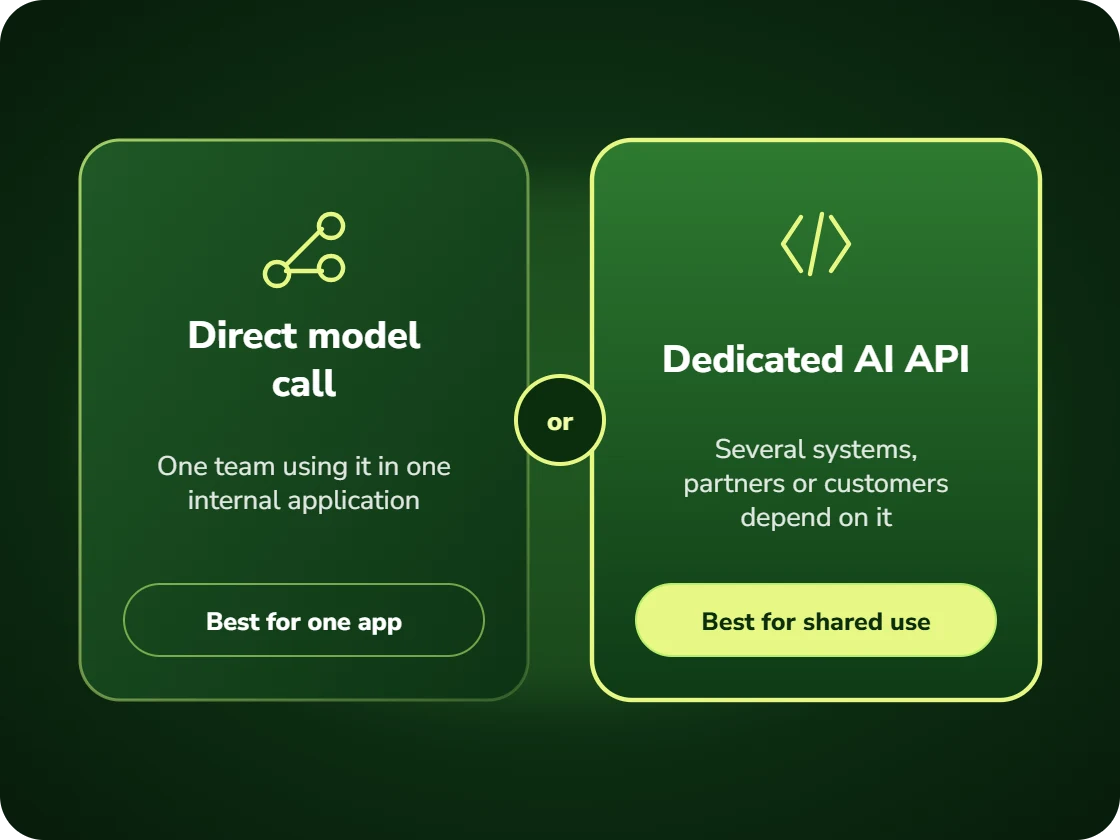
When more than one system consumes the same AI capability. At that point the informal endpoint becomes shared infrastructure whether or not anyone decided it should be.
Also when you expose AI to external partners or customers, where the contract, rate limiting and error semantics are part of the product rather than an internal convenience.
- Organizations where several systems call the same AI capability
- Companies exposing AI functionality to customers or partners
- Teams whose ad-hoc endpoint has become critical without being designed as such
- Platforms needing per-consumer usage limits and cost attribution
- Engineering groups wanting to centralize model access and governance
- Businesses needing to swap models without coordinating downstream releases
Benefits of AI API development
Change models without breaking consumers
A stable versioned contract means the implementation behind it can change freely.
One place for governance
Rate limits, cost controls, PII handling and quality monitoring applied centrally rather than reimplemented per team.
Cost attributed to callers
Per-key spend data, so the team generating the bill is identifiable and can be given a budget.
Failures that degrade, not cascade
Timeouts, circuit breakers and fallbacks stop a slow provider from taking six downstream systems with it.
Caching that pays for itself
Response and semantic caching typically removes a substantial share of requests before they reach a model.
Consumers who can self-serve
Documentation, examples and sandbox keys so integrating teams do not need a meeting to get started.
Business challenges this solves
Shared endpoint with no owner
Critical infrastructure that grew by accident. Formalizing it with contracts and ownership removes the risk.
Model changes breaking downstream
Every prompt change requiring coordination. Versioned contracts decouple implementation from consumers.
One team causing everyone's outage
Unbounded usage exhausting rate limits. Per-key quotas isolate consumers from each other.
Nobody knows who drives the cost
A single large bill with no attribution. Per-key tracking makes accountability possible.
Duplicated AI logic across teams
The same guardrails reimplemented five times, inconsistently. Centralizing removes the divergence.
Provider outage taking down the business
A single dependency with no fallback. Circuit breakers and provider failover contain it.
Features and deliverables
Everything below is in scope on a standard engagement. Nothing here is an upsell discovered halfway through the build.
API design and contracts
Endpoint design, request and response schemas, versioning strategy and a documented deprecation policy.
Authentication and authorization
API key or OAuth authentication with per-key scopes controlling which capabilities each consumer may use.
Rate limiting and quotas
Per-key limits with burst allowance, monthly quotas, and clear headers so consumers can back off correctly.
Caching layer
Exact-match and semantic caching with configurable TTLs, cutting both latency and cost for repeated requests.
Model routing and fallback
Routing by request complexity, automatic failover between providers, and circuit breakers on repeated failure.
Cost governance
Per-key cost attribution, configurable budgets, alerting on anomalies and enforcement when limits are reached.
Observability
Distributed tracing, latency percentiles, error rate by type, token usage and output quality sampling.
Developer experience
OpenAPI specification, generated client libraries, sandbox environment and worked examples.
Technologies we use for AI API development
We are not tied to one vendor. Model and infrastructure choices are made on accuracy, cost per task, latency, and where your data is allowed to live.
Our AI development process
The same five stages on every engagement, so you always know what happens next and what you get at the end of it.
Discovery
We interview the people doing the work, map the workflow end to end, and audit the systems and data behind it.
AI Strategy
Every opportunity gets scored on cost to build, time to value, and annual savings, then ranked.
Pilot Build
We ship the top-ranked automation as a fixed-scope pilot so you see real output before committing further budget.
Implementation
Integration with your live systems, staff training, human-in-the-loop review gates, and a documented rollback path.
Optimization
Monthly accuracy reviews, prompt and retrieval tuning, and a written report on hours and dollars saved.
How long it takes
A typical first engagement, week by week. Complex integrations and regulated environments extend this, and we say so during discovery rather than after.
Discovery and scoping
Process observation, systems audit, data review, and a written estimate of cost and expected saving before anything is built.
Design sign-off
Architecture, data handling rules, review thresholds and success measures agreed in writing.
Build and integration
Development against your real data, connected to your live systems, with weekly demos rather than a single reveal.
Parallel run and testing
The system runs alongside the existing process so accuracy can be compared directly before anyone depends on it.
Launch and handover
Cutover with a rollback path, staff training, full documentation, then 30 days of included tuning.
Industries we deliver AI API development for
SaaS & Technology
AI features inside your product, support deflection, onboarding assistants, and usage analytics.
Financial Services
Document extraction, reconciliation, KYC support, and audit-ready reporting with full traceability.
Logistics & Supply Chain
Document processing, carrier communication, exception handling, and inventory rebalancing.
Retail & E-commerce
Product data enrichment, demand forecasting, support deflection, and personalized merchandising.
Healthcare
Intake, prior authorization, clinical documentation, and revenue-cycle workflows built to respect HIPAA boundaries.
Manufacturing
Quality inspection, maintenance prediction, supplier communication, and production scheduling.
Insurance
First-notice-of-loss intake, claims triage, policy Q&A, and fraud signal detection.
Professional Services
Proposal drafting, timesheet capture, research synthesis, and client reporting at scale.
Real-world use cases
Internal AI platform
A central endpoint every internal team uses, with governance, cost attribution and guardrails applied once.
Partner-facing AI capability
Exposing AI functionality to partners under contract, with per-partner limits and usage billing.
Product API for customers
Customer-facing programmatic access to your AI features, with tiered rate limits by plan.
Model abstraction layer
A stable interface over multiple providers, so provider changes never reach consuming applications.
Document processing service
An extraction endpoint consumed by several internal systems, with consistent validation and error handling.
Embedding and search service
Centralized embedding generation and vector search so every team uses the same model and index.
Why choose DevSolutionsAI for AI API development
Business case before build
Every recommendation carries an estimated cost, timeline, and annual savings figure. If the math does not work, we say so before you spend.
Vendor-neutral by design
We resell nothing and take no platform commissions. Model and infrastructure choices are made on fit, cost, and your data-residency rules.
Fixed-scope pilots
The first engagement is a defined deliverable at a defined price, not an open-ended retainer that quietly grows each quarter.
Built for handover
You own the code, the prompts, the infrastructure, and the documentation. No lock-in to a proprietary wrapper you cannot leave.
Human-in-the-loop where it counts
Anything customer-facing, clinical, financial, or legal gets a review gate, a confidence threshold, and a logged audit trail.
Security reviewed early
Data flow diagrams, retention rules, and access boundaries are agreed in week one, not retrofitted after your security team objects.
Find out what AI API development would cost you, before you commit to anything
Every engagement is quoted after a short discovery, so you get a fixed written price built around your actual volumes rather than a rate card that assumes someone else’s business.
The first call is thirty minutes and free. Bring one workflow. We will tell you what it is likely costing you each year, roughly what automating it would take, and whether we think it is worth doing at all.
- A written savings estimate before any paid work
- Fixed scope and fixed price, agreed up front
- Full ownership of everything we build for you
- An honest recommendation when the numbers do not work
Figures are internal measurements across recent engagements, reported to every client monthly in writing.
Illustrative project scenario
Consolidating nine AI integrations into one governed API
Challenge. A logistics company had nine internal systems calling model providers directly, each with its own prompts, error handling and API keys. Costs appeared as one untraceable bill. A provider rate limit hit during peak season caused three systems to fail simultaneously, with no fallback in any of them.
What we built. A central AI API with versioned contracts, per-consumer authentication and rate limits, semantic caching, automatic failover across two providers, and cost attribution per key. Consuming teams migrated over eight weeks, each behind a stable contract so migration did not require coordinated releases.
Outcome. All nine systems now consume the central API. Semantic caching removed 38% of requests. Total inference cost fell 44% through caching and routing simpler requests to smaller models. A subsequent provider incident caused elevated latency but no consumer-visible failures.
Illustrative project scenario. The figures demonstrate how a project could be scoped and evaluated; they are not verified client results or an audited average.
What clients say about working with us
AI API Development FAQs
Why not just let each team call the model provider directly?
It works while one team is experimenting. It becomes a problem once several systems depend on AI: there is no cost attribution, so nobody knows which team drives the bill; no per-consumer rate limiting, so one team can exhaust the quota for everyone; guardrails get reimplemented inconsistently; and a provider outage hits every system at once with no fallback. Most organizations centralize after an incident rather than before.
How much does caching actually save?
It varies with how repetitive your request patterns are, but it is frequently the single largest cost lever available. On a recent logistics engagement semantic caching absorbed 38% of requests. Products with more standardized queries see higher rates; highly bespoke per-user requests see lower. We measure your actual request distribution during design rather than assuming a figure.
Can the API route between different model providers?
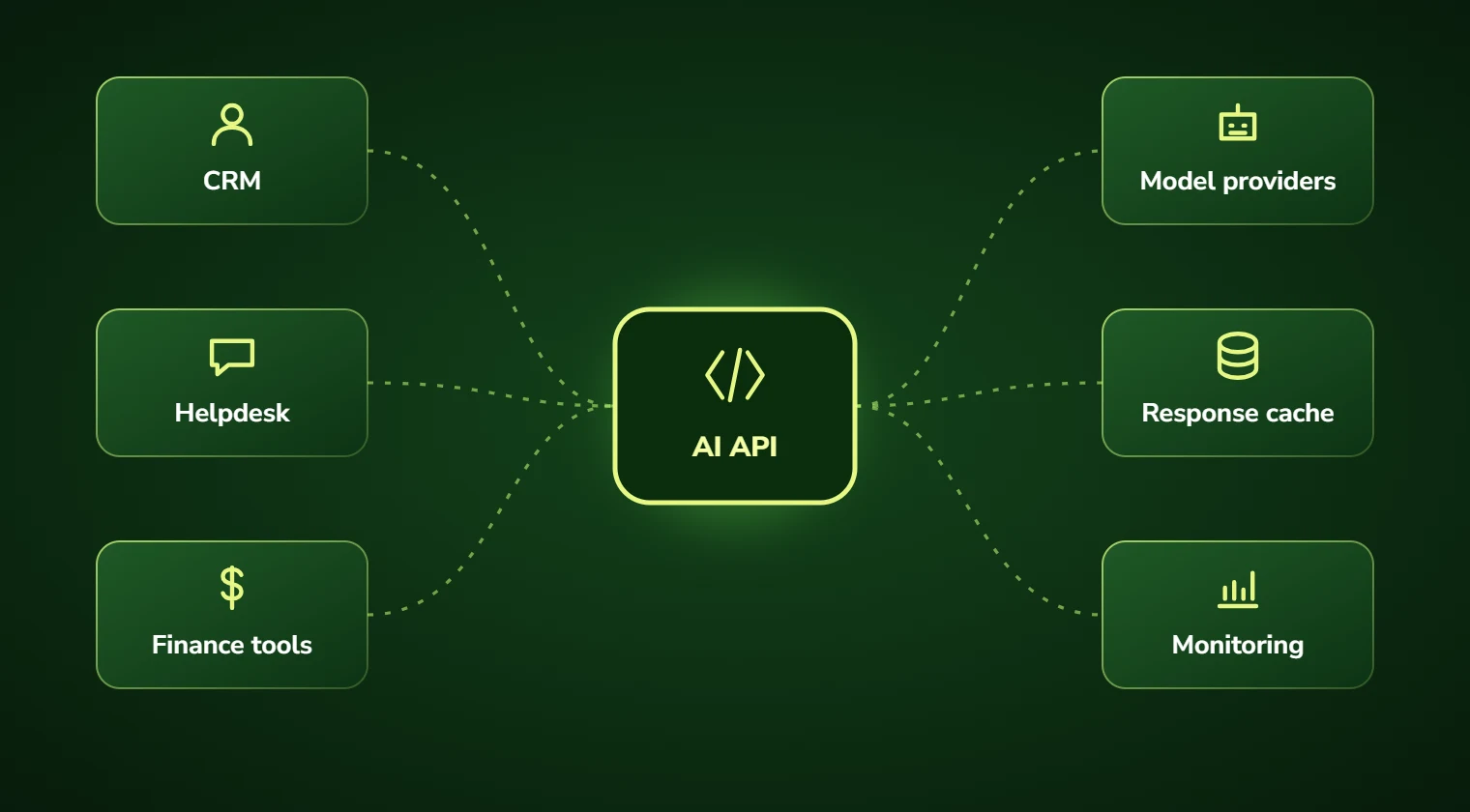
Yes, and this is one of the main reasons to build one. Routing can be by request complexity, cheap models for simple tasks, frontier models for hard ones, and by availability, failing over automatically when a provider degrades. Because consumers sit behind a stable contract, none of that requires downstream changes.
How long does it take to build?
Five to eight weeks for a production API including auth, rate limiting, caching, routing, observability and documentation, after a two-week design phase. Migrating existing consumers usually runs in parallel and takes a few additional weeks depending on how many there are and how well they are tested.
Do you build external partner-facing APIs?
Yes. Externally exposed APIs need more: stricter authentication and scoping, plan-based rate limiting, usage billing integration, a sandbox environment, versioning with a published deprecation policy, and documentation good enough that partners can integrate without support tickets. Those are additive to the internal build.
What happens when we want to change the underlying model?
That is the point of the contract. Consumers call a stable versioned endpoint; the model behind it is an implementation detail. We validate the new model against a regression suite, roll it out behind a feature flag with the ability to revert, and consumers see no change unless output quality genuinely differs, which the quality monitoring would surface.
Services that pair well with this one
Most clients combine two or three of these. We will tell you the right sequence during discovery.
Ready to scope your AI API development project?
Book a free 30-minute consultation. Bring one workflow and leave with a realistic estimate of what it would cost to automate and what it would save.