Supply chain AI solutions built on the data you have, not the data the vendor assumed
Our supply chain AI solutions address forecasting, supplier risk and inventory decisions. We assess data coverage, stockouts, lead times and exceptions before recommending a model or automated workflow.
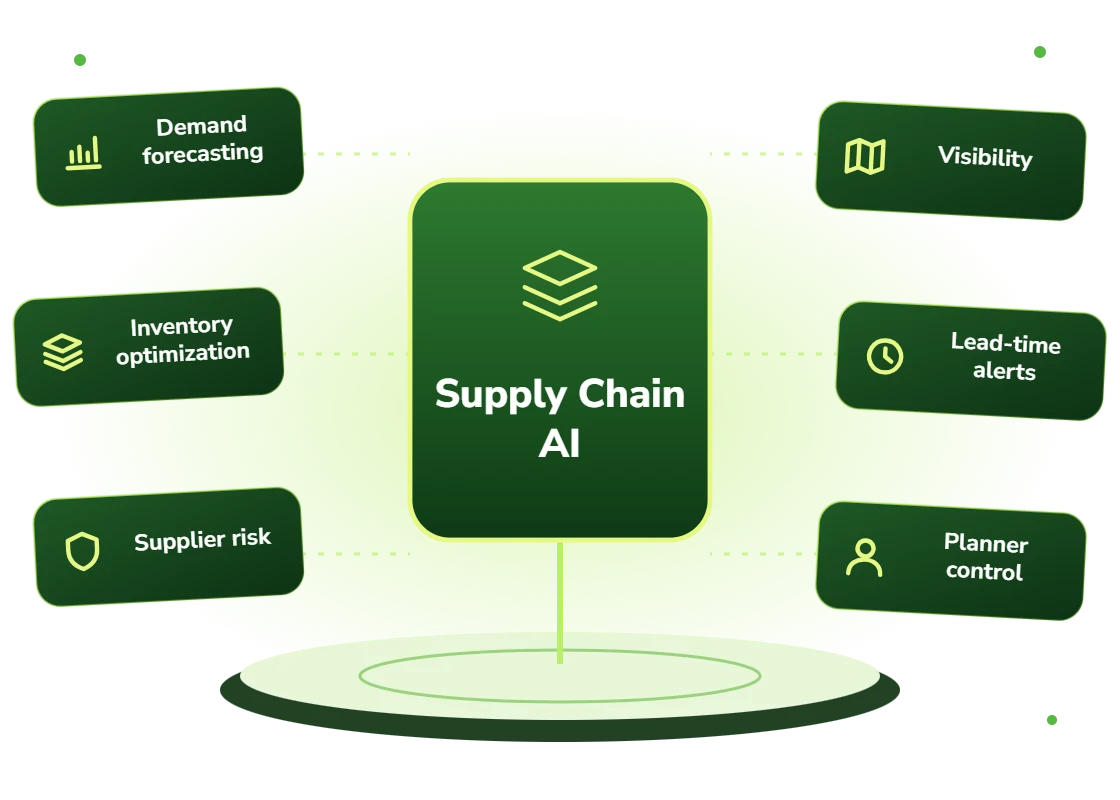
Supply chain AI applies machine learning and language models to planning and sourcing: forecasting demand, optimizing inventory levels and safety stock, assessing supplier risk, processing supplier communications, and supporting response to disruptions. Its effectiveness depends heavily on the quality and completeness of historical data.
Forecasting models trained on distorted history
Sales history is not demand history. It reflects what you could sell given what you had in stock, and if stockouts are not identifiable in the data, a model learns that demand fell when actually supply ran out.
The same applies to promotions, price changes and one-off events. Without them labelled, the model learns patterns that do not exist and produces confident forecasts that are systematically wrong.
Assess the data, then decide what is buildable
The first phase is always a data assessment: what history exists, whether stockouts and promotions can be identified, how lead-time variation is recorded, and where the gaps are.
That determines what is genuinely buildable. Frequently the honest answer is that forecasting should wait and the first project should be supplier documentation or data capture improvement, and we say so.
Supply chain AI solutions: scope and deliverables
Demand forecasting is the headline application and the most data-dependent. Where history supports it, the gains in inventory cost and service level are substantial. Where it does not, models produce confident nonsense.
Supplier risk assessment is less data-dependent and frequently more immediately useful: monitoring supplier communications, delivery performance and external signals for early warning.
Supplier documentation processing, certificates, change notices, delivery confirmations, capacity notifications, is the application that always works because the documents already exist.
And disruption response: when something goes wrong, assembling the picture of what is affected across systems is currently a manual scramble.
- Data readiness assessment before any forecasting commitment
- Demand forecasting with confidence intervals, where data supports it
- Inventory and safety stock optimization against service level targets
- Supplier risk monitoring from performance and external signals
- Supplier document processing: certificates, notices, confirmations
- Disruption impact assessment across affected orders and customers
Supply chain organizations this suits
Businesses carrying significant inventory where the trade-off between working capital and service level is material and currently managed by rule of thumb.
And operations with many suppliers where documentation volume and performance monitoring exceed what the team can handle manually.
- Businesses with significant inventory investment and stockout costs
- Operations managing many suppliers with variable performance
- Companies with seasonal or promotional demand that planning handles poorly
- Manufacturers dependent on single-source or long-lead-time components
- Organizations whose disruption response is a manual scramble
- Teams processing high volumes of supplier documentation manually
Benefits of supply chain AI
Honest feasibility first
A data assessment that tells you what is buildable before you fund a forecasting project on insufficient history.
Forecasts with uncertainty stated
Confidence intervals rather than single numbers, so planners can make risk-appropriate decisions.
Working capital released
Safety stock optimized against actual demand variability rather than a uniform rule of thumb.
Supplier problems seen earlier
Performance degradation and external risk signals surfaced before they become stockouts.
Supplier paperwork absorbed
Certificates, notices and confirmations processed automatically regardless of format.
Faster disruption response
Affected orders, customers and alternatives assembled in minutes rather than a manual scramble.
Business challenges this solves
Forecasts nobody trusts
Models trained on distorted history. Data assessment and proper labelling addresses the cause.
Safety stock by rule of thumb
Uniform buffers regardless of variability. Optimization against actual demand patterns releases capital.
Supplier problems found late
Performance degradation discovered at stockout. Monitoring surfaces it earlier.
Supplier documents by hand
Certificates and notices processed manually. Extraction handles them regardless of format.
Disruption response as a scramble
Manual assembly of impact across systems. Automated assessment gives the picture in minutes.
Vendors assuming perfect data
Proposals requiring history you do not have. We assess first and scope to reality.
Features and deliverables
Everything below is in scope on a standard engagement. Nothing here is an upsell discovered halfway through the build.
Data readiness assessment
Evaluation of history depth, stockout and promotion identifiability, and lead-time recording before any model commitment.
Demand forecasting
Statistical and machine learning forecasting with confidence intervals, seasonality and external signal incorporation.
Inventory optimization
Safety stock and reorder point calculation against service level targets and actual demand variability per item.
Supplier performance monitoring
On-time, in-full, quality and lead-time variability tracked per supplier with degradation alerting.
Supplier risk signals
External signals and communication patterns monitored for early warning of supplier difficulty.
Document processing
Certificates of analysis, change notices, capacity notifications and confirmations extracted and routed.
Disruption impact assessment
When a disruption occurs, affected orders, customers and alternative sources assembled automatically.
ERP and planning integration
Connection into SAP, Oracle, NetSuite, Kinaxis or your existing planning systems.
Technologies we use for supply chain AI
We are not tied to one vendor. Model and infrastructure choices are made on accuracy, cost per task, latency, and where your data is allowed to live.
Our AI development process
The same five stages on every engagement, so you always know what happens next and what you get at the end of it.
Discovery
We interview the people doing the work, map the workflow end to end, and audit the systems and data behind it.
AI Strategy
Every opportunity gets scored on cost to build, time to value, and annual savings, then ranked.
Pilot Build
We ship the top-ranked automation as a fixed-scope pilot so you see real output before committing further budget.
Implementation
Integration with your live systems, staff training, human-in-the-loop review gates, and a documented rollback path.
Optimization
Monthly accuracy reviews, prompt and retrieval tuning, and a written report on hours and dollars saved.
How long it takes
A typical first engagement, week by week. Complex integrations and regulated environments extend this, and we say so during discovery rather than after.
Discovery and scoping
Process observation, systems audit, data review, and a written estimate of cost and expected saving before anything is built.
Design sign-off
Architecture, data handling rules, review thresholds and success measures agreed in writing.
Build and integration
Development against your real data, connected to your live systems, with weekly demos rather than a single reveal.
Parallel run and testing
The system runs alongside the existing process so accuracy can be compared directly before anyone depends on it.
Launch and handover
Cutover with a rollback path, staff training, full documentation, then 30 days of included tuning.
Industries we deliver supply chain AI for
Logistics & Supply Chain
Document processing, carrier communication, exception handling, and inventory rebalancing.
Manufacturing
Quality inspection, maintenance prediction, supplier communication, and production scheduling.
Retail & E-commerce
Product data enrichment, demand forecasting, support deflection, and personalized merchandising.
Construction
Bid takeoffs, submittal review, RFI drafting, and field-report summarization.
Healthcare
Intake, prior authorization, clinical documentation, and revenue-cycle workflows built to respect HIPAA boundaries.
Financial Services
Document extraction, reconciliation, KYC support, and audit-ready reporting with full traceability.
Professional Services
Proposal drafting, timesheet capture, research synthesis, and client reporting at scale.
Insurance
First-notice-of-loss intake, claims triage, policy Q&A, and fraud signal detection.
Real-world use cases
Demand forecasting
Item-level forecasts with confidence intervals feeding planning, where data quality supports it.
Safety stock optimization
Buffers calculated per item against actual variability rather than a uniform policy.
Supplier scorecarding
Performance tracked continuously with degradation flagged before it becomes a supply problem.
Certificate processing
Certificates of analysis and conformance extracted and matched to receipts automatically.
Disruption response
Impact assessed across affected orders and customers within minutes of a disruption being identified.
Long-lead component planning
Single-source and long-lead items monitored with earlier warning on supply risk.
Why choose DevSolutionsAI for supply chain AI
Business case before build
Every recommendation carries an estimated cost, timeline, and annual savings figure. If the math does not work, we say so before you spend.
Vendor-neutral by design
We resell nothing and take no platform commissions. Model and infrastructure choices are made on fit, cost, and your data-residency rules.
Fixed-scope pilots
The first engagement is a defined deliverable at a defined price, not an open-ended retainer that quietly grows each quarter.
Built for handover
You own the code, the prompts, the infrastructure, and the documentation. No lock-in to a proprietary wrapper you cannot leave.
Human-in-the-loop where it counts
Anything customer-facing, clinical, financial, or legal gets a review gate, a confidence threshold, and a logged audit trail.
Security reviewed early
Data flow diagrams, retention rules, and access boundaries are agreed in week one, not retrofitted after your security team objects.
Find out what supply chain AI would cost you, before you commit to anything
Every engagement is quoted after a short discovery, so you get a fixed written price built around your actual volumes rather than a rate card that assumes someone else’s business.
The first call is thirty minutes and free. Bring one workflow. We will tell you what it is likely costing you each year, roughly what automating it would take, and whether we think it is worth doing at all.
- A written savings estimate before any paid work
- Fixed scope and fixed price, agreed up front
- Full ownership of everything we build for you
- An honest recommendation when the numbers do not work
Figures are internal measurements across recent engagements, reported to every client monthly in writing.
Illustrative project scenario
Finding out the forecasting project was not ready, and doing something useful instead
Challenge. A distributor had budgeted for a demand forecasting implementation. The data assessment found that stockouts were not identifiable in historical sales data, promotional periods were unlabelled, and lead-time variation was recorded inconsistently across suppliers. A forecasting model on that history would have learned from systematically distorted demand.
What we built. We recommended against the forecasting build and instead implemented stockout and promotion flagging in the data pipeline, automated supplier certificate and confirmation processing, and supplier performance monitoring from delivery records that were reliable. Forecasting was deferred by twelve months to accumulate clean history.
Outcome. The document processing and supplier monitoring delivered immediate value with no data dependency. Twelve months later, with clean labelled history accumulating, the forecasting project proceeded on a sound basis. The client’s view was that being told to wait saved them from a failed implementation.
Illustrative project scenario. The figures demonstrate how a project could be scoped and evaluated; they are not verified client results or an audited average.
What clients say about working with us
Supply Chain AI FAQs
Why do supply chain AI projects fail so often?
Usually data rather than modelling. Sales history is not demand history, it reflects what you could sell given available stock. If stockouts are not identifiable in the data, a model learns that demand fell when actually supply ran out, and produces confident forecasts that are systematically wrong. Unlabelled promotions and price changes cause the same problem. This is why we assess data before proposing a forecasting build.
What data do we need for demand forecasting?
At minimum two to three years of history, with stockout periods identifiable, promotional and price change periods labelled, and lead times recorded consistently. Many organizations have the sales history but not the labelling, which is recoverable, but it takes time to accumulate going forward. We tell you honestly where you stand rather than building on what is available.
What if our data is not ready?
Then we recommend something else first, which happens regularly. Document processing, supplier performance monitoring and disruption response all work on data you already have reliably. Meanwhile we can implement the data capture improvements, stockout flagging, promotion labelling, that make forecasting viable in a year. That sequence produces value immediately and a sound forecasting foundation later.
How accurate will the forecast be?
It depends entirely on your demand patterns and data quality, and any vendor quoting a figure before seeing your data is guessing. We backtest against your actual history during assessment and give you measured accuracy on your own items before you commit. Forecasts are also delivered with confidence intervals rather than as single numbers, because a planner needs to know how uncertain the number is.
Can it help during a disruption?
Yes, and this is one of the more immediately valuable applications. When a supplier fails or a route is disrupted, assembling the picture of which orders, customers and downstream commitments are affected is currently a manual scramble across systems. Automating that assessment turns hours of investigation into minutes, which materially affects how well you respond.
What does supply chain AI cost?
A data readiness assessment is $8,000 to $16,000 over two to three weeks and tells you what is genuinely buildable. Document processing and supplier monitoring typically run $30,000 to $60,000. Forecasting and inventory optimization run $55,000 to $120,000 where the data supports it. We would rather sell you the assessment and then decline the forecasting work than build on inadequate data.
Services that pair well with this one
Most clients combine two or three of these. We will tell you the right sequence during discovery.
Ready to scope your supply chain AI project?
Book a free 30-minute consultation. Bring one workflow and leave with a realistic estimate of what it would cost to automate and what it would save.