Inventory automation services that starts with whether your stock data is accurate
Our inventory automation services begin with stock accuracy and replenishment rules. We assess the available history, lead times and exceptions before automating reordering or recommending inventory changes.
AI inventory automation manages stock levels and replenishment using demand patterns, lead times and variability rather than fixed reorder points. It covers automated purchase order generation, safety stock optimization, stock accuracy improvement and exception handling for supply disruptions.
Automating reorders on stock numbers that are wrong
Most inventory systems record a quantity that does not match what is physically on the shelf. Shrinkage, receiving errors, unrecorded movements and returns all cause drift, and cycle counting rarely keeps pace.
Automating replenishment on top of that makes the errors compound faster. The system orders confidently against a number that was wrong.
Establish accuracy, then automate
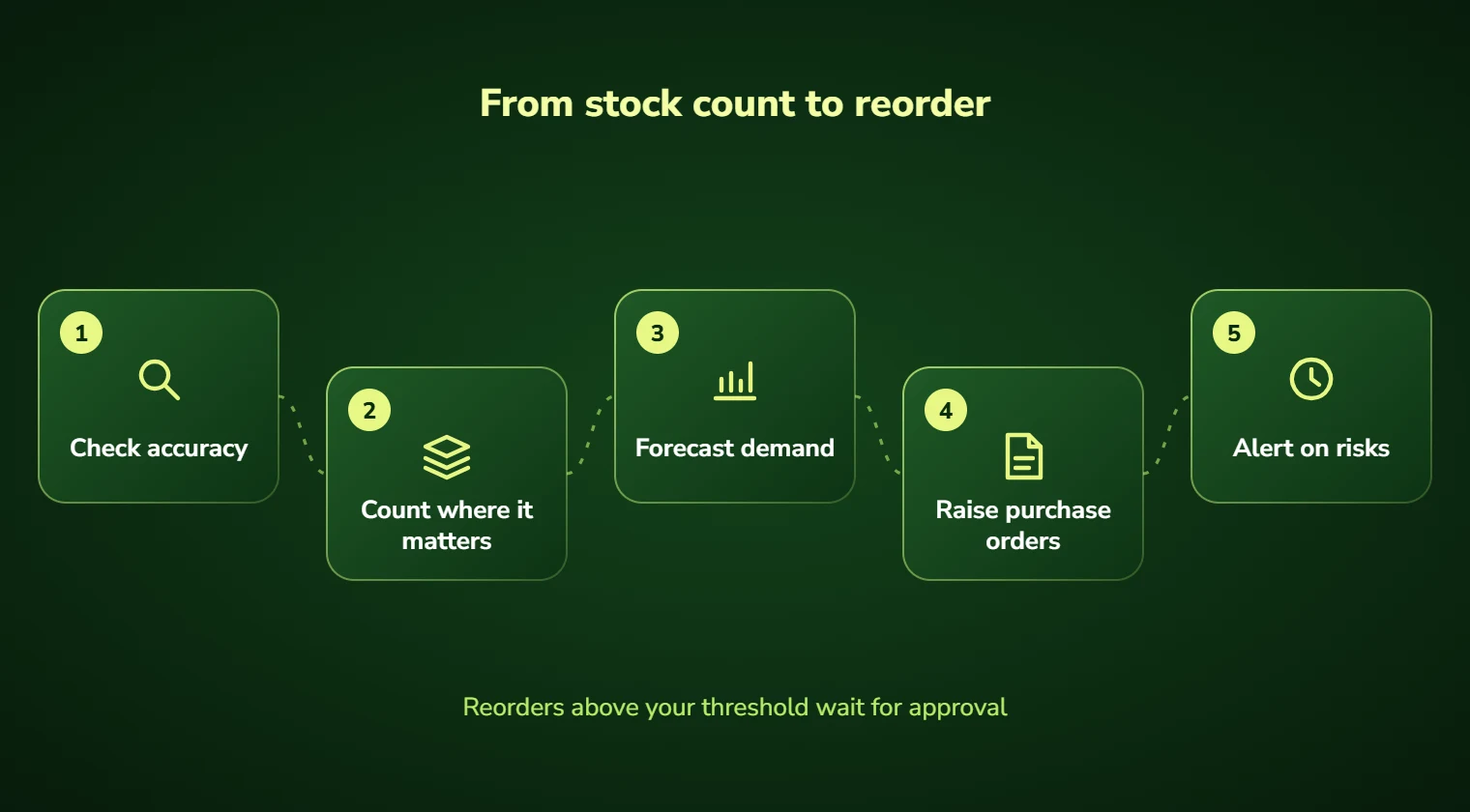
We measure record-to-physical accuracy before automating anything, and where it is poor we address that first through targeted cycle counting and root cause analysis on the discrepancies.
Then replenishment automation on a foundation that reflects reality, with demand variability driving safety stock rather than a uniform rule applied to every item.
Inventory automation services: scope and deliverables
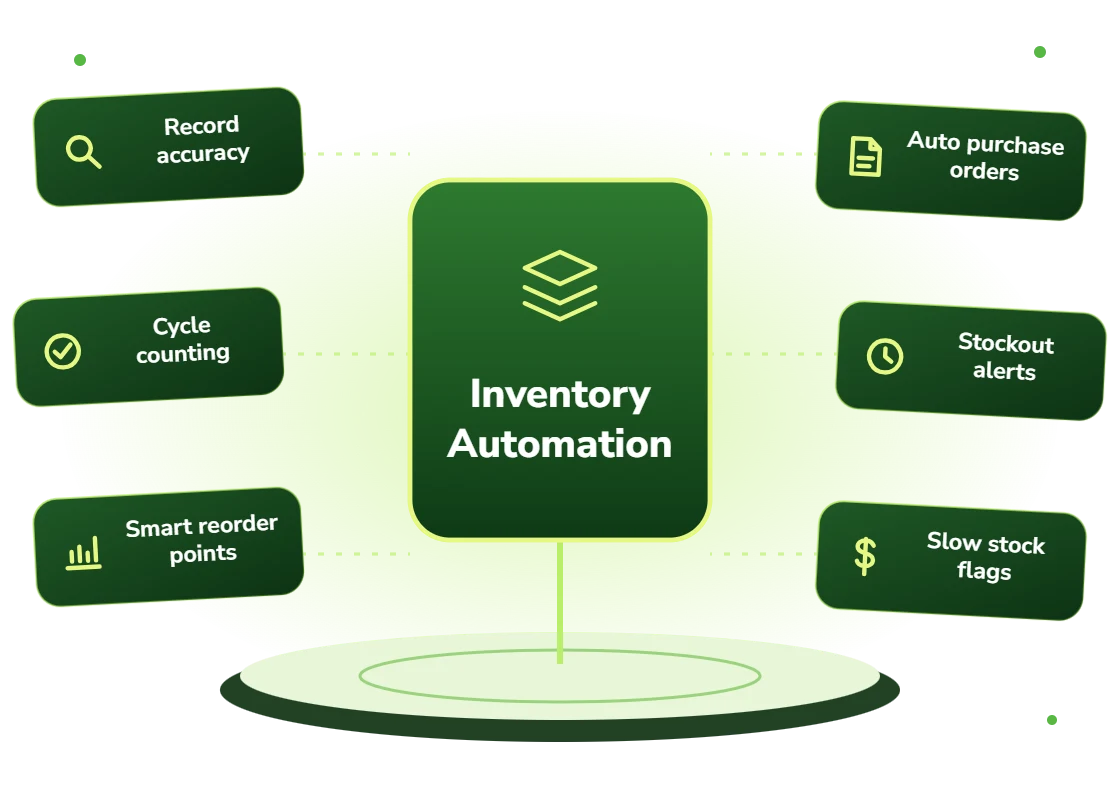
Stock accuracy first, because everything downstream depends on it. Measuring record-to-physical variance, finding where discrepancies originate, and targeting counting effort at the items where accuracy actually matters.
Then replenishment: reorder points and quantities driven by demand variability and lead time variability per item rather than a uniform policy that over-stocks predictable items and under-stocks volatile ones.
Exception handling: supplier delays, demand spikes and stockout risks surfaced with recommended action rather than discovered when the shelf is empty.
And obsolescence, which is the cost nobody tracks until a write-off.
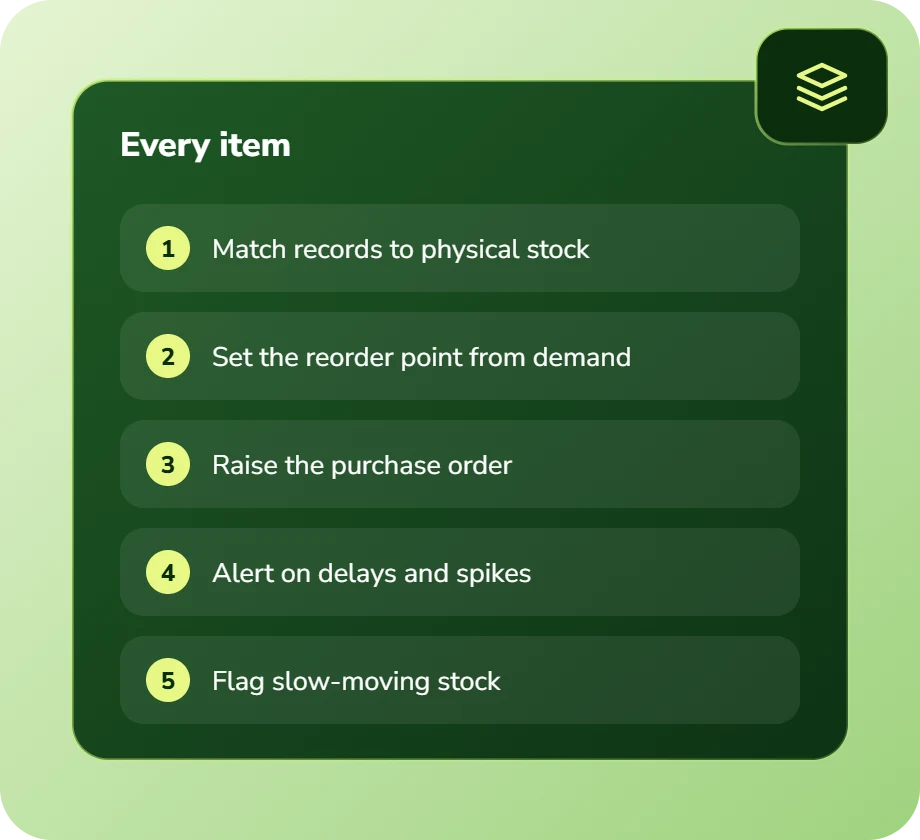
- Record-to-physical accuracy measurement and root cause analysis
- Targeted cycle counting focused where accuracy matters most
- Item-level reorder points driven by actual demand and lead time variability
- Automated purchase order generation with approval thresholds
- Exception alerting on supplier delays, demand spikes and stockout risk
- Obsolescence and slow-moving stock identification before write-off
Who this suits
Businesses carrying enough inventory that the working capital trade-off is material, and where stockouts have measurable cost in lost sales or production downtime.
And operations where replenishment is currently managed by rule of thumb or by one experienced person’s judgement, which is both effective and fragile.
- Businesses with significant inventory investment and stockout costs
- Operations with many SKUs where per-item management is impractical
- Companies where safety stock is set by a uniform rule of thumb
- Businesses whose stock records diverge from physical reality
- Operations dependent on one person’s replenishment judgement
- Companies with recurring obsolescence write-offs
Benefits of inventory automation
Accuracy established first
Record-to-physical variance measured before automating, because automating on wrong numbers compounds the error.
Working capital released
Safety stock set per item against actual variability rather than a uniform buffer that over-stocks the predictable.
Fewer stockouts on volatile items
Items with genuinely variable demand get appropriate buffers instead of the same rule as steady ones.
Counting effort targeted
Cycle counting focused where accuracy matters most rather than spread evenly across every SKU.
Exceptions surfaced early
Supplier delays and demand spikes flagged with recommended action before they become stockouts.
Knowledge out of one head
Replenishment judgement encoded rather than depending on one experienced person remaining.
Business challenges this solves
Stock records not matching reality
Automation compounding errors. Accuracy measured and addressed before automating.
Uniform safety stock
Same buffer for predictable and volatile items. Per-item variability-driven levels.
Stockouts on the wrong items
Volatile demand under-buffered. Variability-aware reorder points fix it.
Counting spread evenly
Effort wasted on low-value items. Targeted counting where accuracy matters.
One person managing replenishment
Judgement resident in one head. Encoded logic removes the dependency.
Obsolescence found at write-off
Slow-moving stock unnoticed. Early identification enables action.
Features and deliverables
Everything below is in scope on a standard engagement. Nothing here is an upsell discovered halfway through the build.
Stock accuracy assessment
Record-to-physical variance measured by category, with root cause analysis on where discrepancies originate.
Targeted cycle counting
Counting frequency driven by item value, movement rate and historical variance rather than applied uniformly.
Demand variability analysis
Per-item demand pattern and variability characterized, distinguishing genuinely volatile items from steady ones.
Reorder point optimization
Item-level reorder points and quantities calculated against demand variability, lead time variability and service targets.
Automated purchase orders
PO generation with approval thresholds, supplier selection rules and consolidation logic.
Exception alerting
Supplier delays, demand anomalies and projected stockouts surfaced with recommended action.
Obsolescence detection
Slow-moving and at-risk stock identified early enough for action rather than at write-off.
ERP and WMS integration
Built into your existing inventory, warehouse and purchasing systems rather than replacing them.
Technologies we use for inventory automation
We are not tied to one vendor. Model and infrastructure choices are made on accuracy, cost per task, latency, and where your data is allowed to live.
Our AI development process
The same five stages on every engagement, so you always know what happens next and what you get at the end of it.
Discovery
We interview the people doing the work, map the workflow end to end, and audit the systems and data behind it.
AI Strategy
Every opportunity gets scored on cost to build, time to value, and annual savings, then ranked.
Pilot Build
We ship the top-ranked automation as a fixed-scope pilot so you see real output before committing further budget.
Implementation
Integration with your live systems, staff training, human-in-the-loop review gates, and a documented rollback path.
Optimization
Monthly accuracy reviews, prompt and retrieval tuning, and a written report on hours and dollars saved.
How long it takes
A typical first engagement, week by week. Complex integrations and regulated environments extend this, and we say so during discovery rather than after.
Discovery and scoping
Process observation, systems audit, data review, and a written estimate of cost and expected saving before anything is built.
Design sign-off
Architecture, data handling rules, review thresholds and success measures agreed in writing.
Build and integration
Development against your real data, connected to your live systems, with weekly demos rather than a single reveal.
Parallel run and testing
The system runs alongside the existing process so accuracy can be compared directly before anyone depends on it.
Launch and handover
Cutover with a rollback path, staff training, full documentation, then 30 days of included tuning.
Industries we deliver inventory automation for
Retail & E-commerce
Product data enrichment, demand forecasting, support deflection, and personalized merchandising.
Manufacturing
Quality inspection, maintenance prediction, supplier communication, and production scheduling.
Logistics & Supply Chain
Document processing, carrier communication, exception handling, and inventory rebalancing.
Construction
Bid takeoffs, submittal review, RFI drafting, and field-report summarization.
Healthcare
Intake, prior authorization, clinical documentation, and revenue-cycle workflows built to respect HIPAA boundaries.
Professional Services
Proposal drafting, timesheet capture, research synthesis, and client reporting at scale.
Financial Services
Document extraction, reconciliation, KYC support, and audit-ready reporting with full traceability.
Insurance
First-notice-of-loss intake, claims triage, policy Q&A, and fraud signal detection.
Real-world use cases
Automated replenishment
Purchase orders generated against demand-driven reorder points with approval thresholds.
Safety stock optimization
Buffers set per item against actual variability, releasing capital from over-stocked predictable items.
Stock accuracy programme
Measuring and improving record-to-physical accuracy with targeted counting.
Stockout prevention
Projected stockouts flagged with lead time in hand to act.
Obsolescence management
Slow-moving stock identified early enough to discount, return or redeploy.
Multi-location balancing
Stock rebalanced between locations rather than reordering where inventory already exists elsewhere.
Why choose DevSolutionsAI for inventory automation
Business case before build
Every recommendation carries an estimated cost, timeline, and annual savings figure. If the math does not work, we say so before you spend.
Vendor-neutral by design
We resell nothing and take no platform commissions. Model and infrastructure choices are made on fit, cost, and your data-residency rules.
Fixed-scope pilots
The first engagement is a defined deliverable at a defined price, not an open-ended retainer that quietly grows each quarter.
Built for handover
You own the code, the prompts, the infrastructure, and the documentation. No lock-in to a proprietary wrapper you cannot leave.
Human-in-the-loop where it counts
Anything customer-facing, clinical, financial, or legal gets a review gate, a confidence threshold, and a logged audit trail.
Security reviewed early
Data flow diagrams, retention rules, and access boundaries are agreed in week one, not retrofitted after your security team objects.
Find out what inventory automation would cost you, before you commit to anything
Every engagement is quoted after a short discovery, so you get a fixed written price built around your actual volumes rather than a rate card that assumes someone else’s business.
The first call is thirty minutes and free. Bring one workflow. We will tell you what it is likely costing you each year, roughly what automating it would take, and whether we think it is worth doing at all.
- A written savings estimate before any paid work
- Fixed scope and fixed price, agreed up front
- Full ownership of everything we build for you
- An honest recommendation when the numbers do not work
Figures are internal measurements across recent engagements, reported to every client monthly in writing.
Illustrative project scenario
Finding the stock records were wrong before automating anything
Challenge. A distributor wanted automated replenishment across 34,000 SKUs. Their existing process used a uniform safety stock rule and one experienced planner’s judgement on important items. They had budgeted for the automation build.
What we built. The assessment measured record-to-physical accuracy first and found it was materially worse than assumed, concentrated in a specific warehouse zone with a receiving process problem. We recommended fixing that and running targeted cycle counting before automating, then built replenishment on the corrected foundation with item-level variability driving safety stock.
Outcome. The receiving process fix and targeted counting brought accuracy to a usable level within two months. Replenishment automation then released working capital from over-stocked predictable items while improving availability on volatile ones. The planner moved to strategic and volatile items with automation handling the long tail.
Illustrative project scenario. The figures demonstrate how a project could be scoped and evaluated; they are not verified client results or an audited average.
What clients say about working with us
Inventory Automation FAQs
Why does stock accuracy matter before automation?
Because automated replenishment orders confidently against whatever number the system holds. If that number does not match physical reality, automation makes the errors compound faster rather than fixing them. On a recent engagement we found accuracy was materially worse than assumed and traced it to a receiving process problem in one warehouse zone, fixing that first was the difference between automation working and automation amplifying a data problem.
What is wrong with a uniform safety stock rule?
It over-stocks predictable items and under-stocks volatile ones simultaneously. Two items with the same average demand can have completely different variability, and applying the same buffer to both ties up capital on one while causing stockouts on the other. Item-level safety stock driven by actual demand and lead time variability addresses both at once.
Does this replace our inventory planner?
Usually it changes what they focus on. An experienced planner frequently outperforms automation on a few hundred important or strategic items and cannot scale beyond that. The effective pattern is automation handling the long tail while the planner concentrates on the items where judgement genuinely adds value.
What if our demand history is poor?
Then some of this is not viable yet and we will say so. Automated replenishment needs demand history with stockout periods identifiable, otherwise the system learns that demand fell when supply ran out. The assessment establishes whether your data supports it, and where it does not the useful first step is improving capture.
Does it integrate with our ERP or WMS?
Yes, we build into your existing inventory, warehouse and purchasing systems rather than replacing them. Purchase orders are generated through the ERP’s supported interfaces so its own approval workflow and controls still apply.
What does inventory automation cost?
A two to three week assessment covering stock accuracy, demand variability and opportunity sizing runs $10,000 to $18,000, and frequently changes the plan. A replenishment automation build typically runs $45,000 to $95,000 depending on SKU count and integration complexity. Payback is usually measured on working capital released plus stockout reduction.
Services that pair well with this one
Most clients combine two or three of these. We will tell you the right sequence during discovery.
Ready to scope your inventory automation project?
Book a free 30-minute consultation. Bring one workflow and leave with a realistic estimate of what it would cost to automate and what it would save.