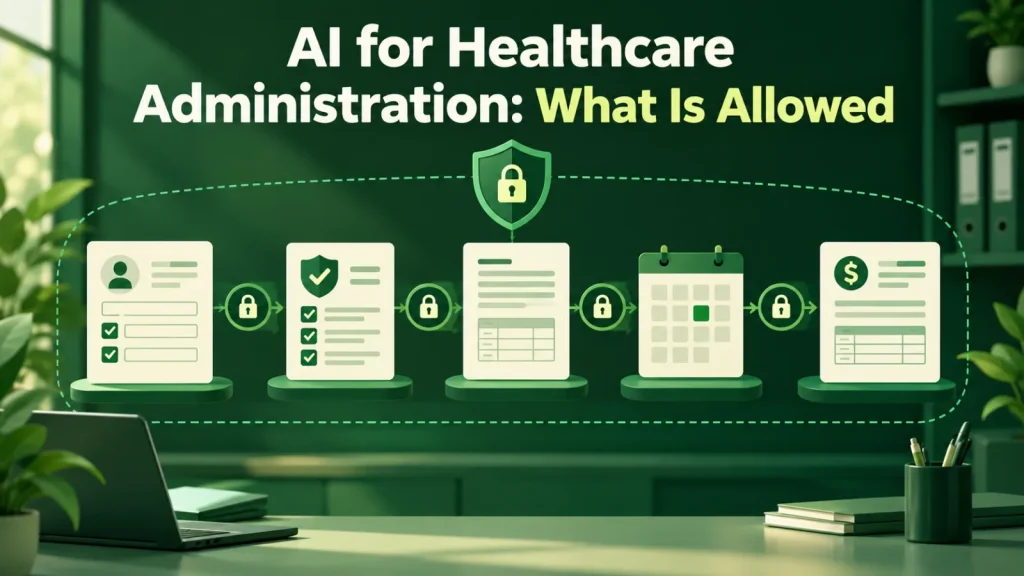
AI in healthcare administration can support intake, eligibility checks and documentation workflows. This guide focuses on administrative use cases and the data handling, review and vendor questions to assess before deployment. We also include a phased rollout plan and the workflows to leave alone for now.
Draw the line in the right place
Healthcare AI conversations tend to jump straight to diagnosis, which is the hardest problem, the most regulated, and the least likely to be where your practice is losing money. However, the administrative layer around care is a different matter entirely: it is enormous, it is expensive, and most of it involves no clinical judgment at all.
For example, prior authorization, eligibility checks, appointment scheduling, referral coordination, claim denial management and clinical documentation support are all administrative workflows. They handle protected health information, which brings real obligations, but they do not require the system to make a medical decision.
That distinction also shapes everything else about AI in healthcare administration. Because administrative tools draft, check and route rather than diagnose, the review work stays manageable. In practice, the person who signs off is usually the same staff member who does the task today.
Where AI in healthcare administration recovers hours
- Prior authorization. Assembling the clinical justification packet from the record, submitting it, and tracking the response. One of the most reliably hated tasks in any practice and one of the best automation candidates.
- Clinical documentation support. Ambient capture and structured note drafting, reviewed and signed by the clinician. The clinician stays accountable, but the typing goes away.
- Eligibility and benefits verification. High volume, rule-driven, currently done by staff on hold with payers.
- Denial management. Classifying denials, identifying the fixable ones, and drafting appeals with the supporting documentation attached.
- Scheduling and reminders. Two-way rescheduling that fills cancellations, which usually pays for itself faster than anything else here.
Each of these keeps AI in healthcare administration rather than in clinical care: the system prepares the work, and staff make the calls. For example, suppose a hypothetical front desk spends twelve hours a week on hold verifying eligibility. So if the routine checks run automatically and only the exceptions reach a person, most of that time goes back to patients at the desk.
What HIPAA actually requires of a vendor
Non-negotiable. So if a vendor hesitates on any of these, the conversation should end.
-
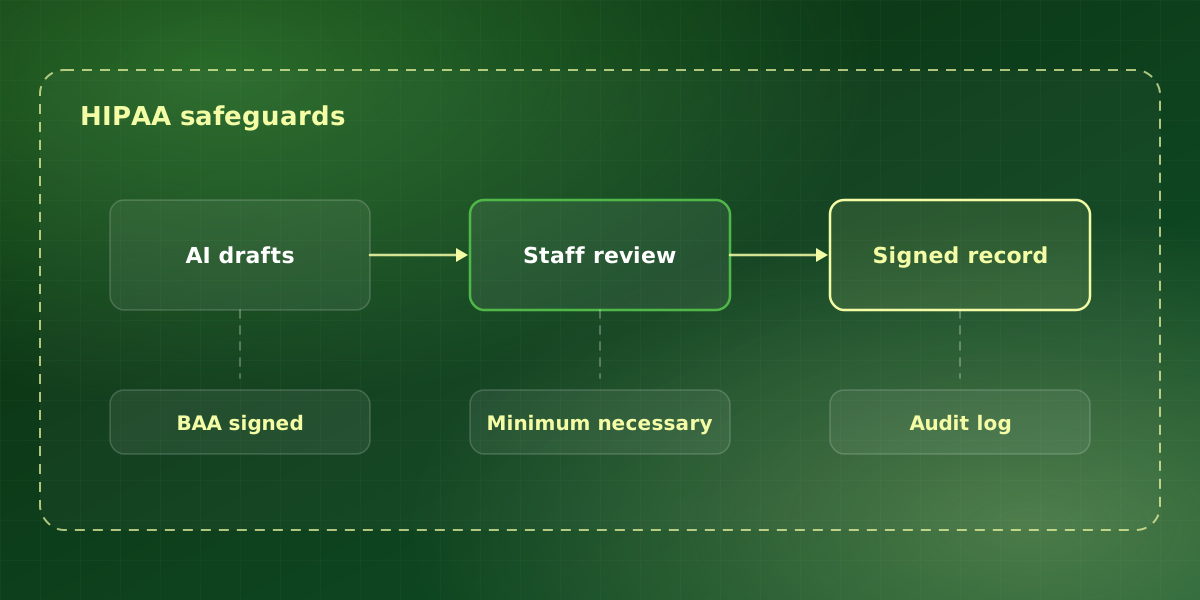
A signed Business Associate Agreement
Any vendor handling protected health information must sign a BAA. This also includes the AI provider in the chain, not just the consultancy. Ask specifically which model provider is used and under what agreement.
-
No training on your data
Contractually explicit, not a settings toggle. Enterprise API tiers from the major providers offer this; consumer tiers generally do not.
-
Minimum necessary access
The system sees the fields needed for the task and no more. De-identify wherever the workflow permits it, which is more often than teams assume. HHS also sets out the underlying standard in its guidance on the HIPAA Minimum Necessary Requirement.
-
Complete audit logging
Who accessed what, when, and what the system did with it. This is a HIPAA requirement independently of AI, and AI workflows must not create a gap in it.
-
Documented human accountability
A named person accountable for every clinical or billing output. The AI drafts, but a qualified human signs.
Questions for any healthcare administration AI vendor
Beyond the five requirements above, these questions separate vendors prepared for AI in healthcare administration from hopeful ones. Ask for the answers in writing, because verbal assurances do not survive an audit:
- Model provider. Which provider processes our data, and does its agreement cover protected health information?
- Retention. Where is data stored, and for how long, including prompts, outputs and logs?
- Audit access. Can we pull the full access history for a single patient record on request?
- Review path. How does each output reach a person before it enters the record or goes to a payer?
- Incident response. Who tells us about a breach or a misdirected output, and how quickly?
- Exit. What happens to our data, and to any derived data, when the contract ends?
Clear written answers also shorten your own compliance review, since your team can file them with the security assessment.
How we phase the rollout
We roll out in stages so the compliance track record builds alongside the time savings.
- Pick one workflow with clear volume. Prior authorization or eligibility checks usually make the best start, because both have measurable volume and turnaround time.
- Finish the paperwork before the build. BAAs, the security assessment and data-flow documentation come first. In practice, this is where most of the extra compliance time in a healthcare timeline goes.
- Review every output at first. Staff approve every draft in the early weeks. Later, low-risk outputs such as reminders can move to sampled review. However, anything entering the record or going to a payer keeps a named human signer.
- Expand from evidence. Once the first workflow runs cleanly, add the next one on the list. The documentation from phase one then makes each later approval faster, because reviewers already know the data flows.
Measuring results from AI in healthcare administration
Pick the metric before the build, since healthcare teams are rightly skeptical of claims about AI in administration. For prior authorization, that is usually turnaround time and the share of requests needing rework. Eligibility checks call for staff hours per verification, while scheduling calls for filled cancellations per week. Then re-measure after each phase and share the numbers with the staff whose work changed, because their trust decides adoption. Measured results also make AI in healthcare administration easier to expand, since each new approval rests on evidence.
What to stay away from, for now
Avoid anything that produces a clinical recommendation without a clinician in the loop, anything patient-facing that could be construed as medical advice, and any workflow where the AI output goes directly into the record without review. These are not merely risky; in fact, in several cases they cross into medical device regulation, which is a different regulatory regime with a different cost structure.
A simple test helps here. If a workflow’s output could change what care a patient receives, treat it as clinical and keep it out of scope for now. If it only changes how fast paperwork moves, then it belongs on the administrative list.
The administrative use cases above carry none of that exposure while representing the larger share of recoverable time in most practices. Start there, build the compliance track record, and revisit the clinical edge later with evidence behind you.
Frequently asked questions
Can we use ChatGPT in a medical practice?
Does AI-assisted documentation affect billing compliance?
What about state-level AI regulations?
How long does a healthcare AI project take?
For implementation support, explore our healthcare AI solutions or discuss your workflow in a free consultation.
Review HHS guidance on the HIPAA Security Rule with your compliance team. A cloud service provider handling ePHI on behalf of a covered entity or business associate may require a HIPAA-compliant business associate agreement; a product label alone does not establish compliance.