Recommendation Systems

Recommendation system development with measurable evaluation

Our recommendation system development work connects relevant products or content to user context. We design data pipelines, ranking and controlled tests so you can assess the effect on business outcomes.

Free 30-minute consultation
Fixed-scope pilots
U.S.-based team
Custom, not off-the-shelf
SOC 2-aligned practices
ROI tracked in writing
What is a recommendation system?

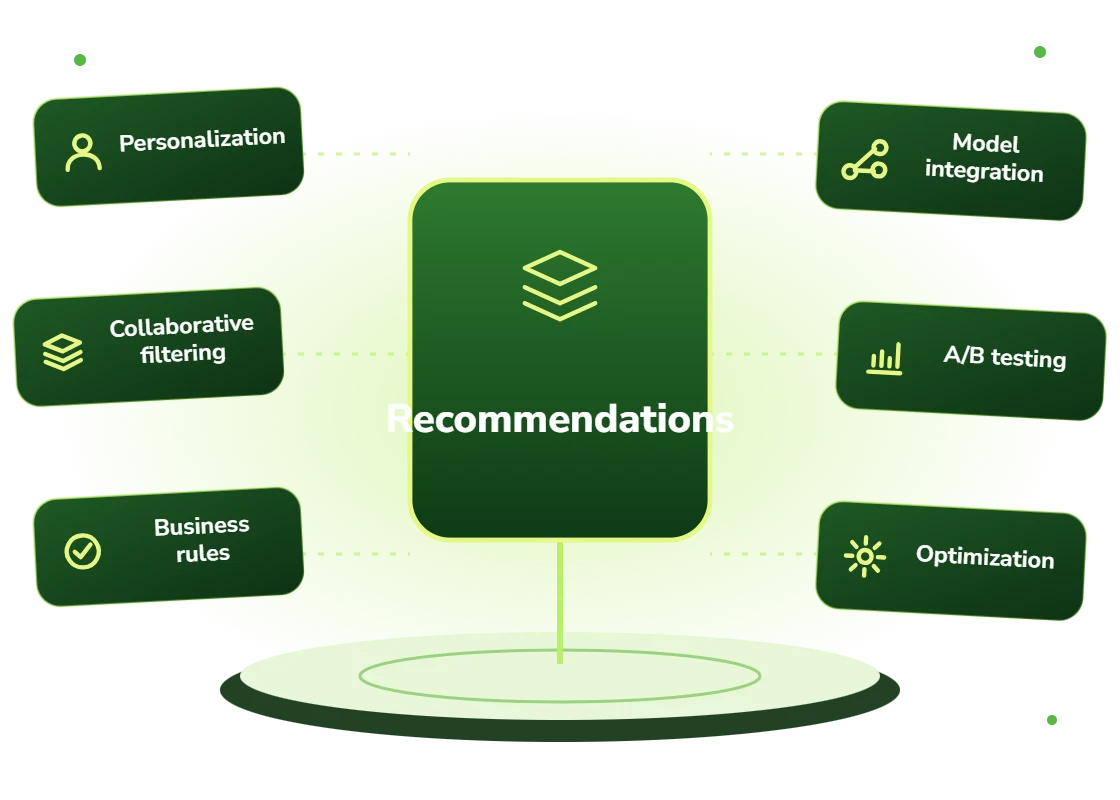
A recommendation system predicts which items a user is most likely to want, using their behaviour, similar users’ behaviour, and item characteristics. Common approaches include collaborative filtering, content-based matching and hybrid methods. Measuring genuine business uplift requires controlled experimentation rather than attributing all recommendation-driven revenue to the system.

7+
Years building AI systems
240+
Projects delivered
4.8
Avg. months to payback
38
U.S. states served
The Problem

The uplift number that does not survive a holdout

The standard recommendation metric is revenue from sessions where someone clicked a recommendation. That number is always large and always misleading, because it includes customers who would have found and bought the item anyway.

Without a proper holdout group, you cannot separate genuine incremental revenue from revenue you would have received regardless, and most reported recommendation ROI has this problem.

Our Approach

Holdout testing from the start

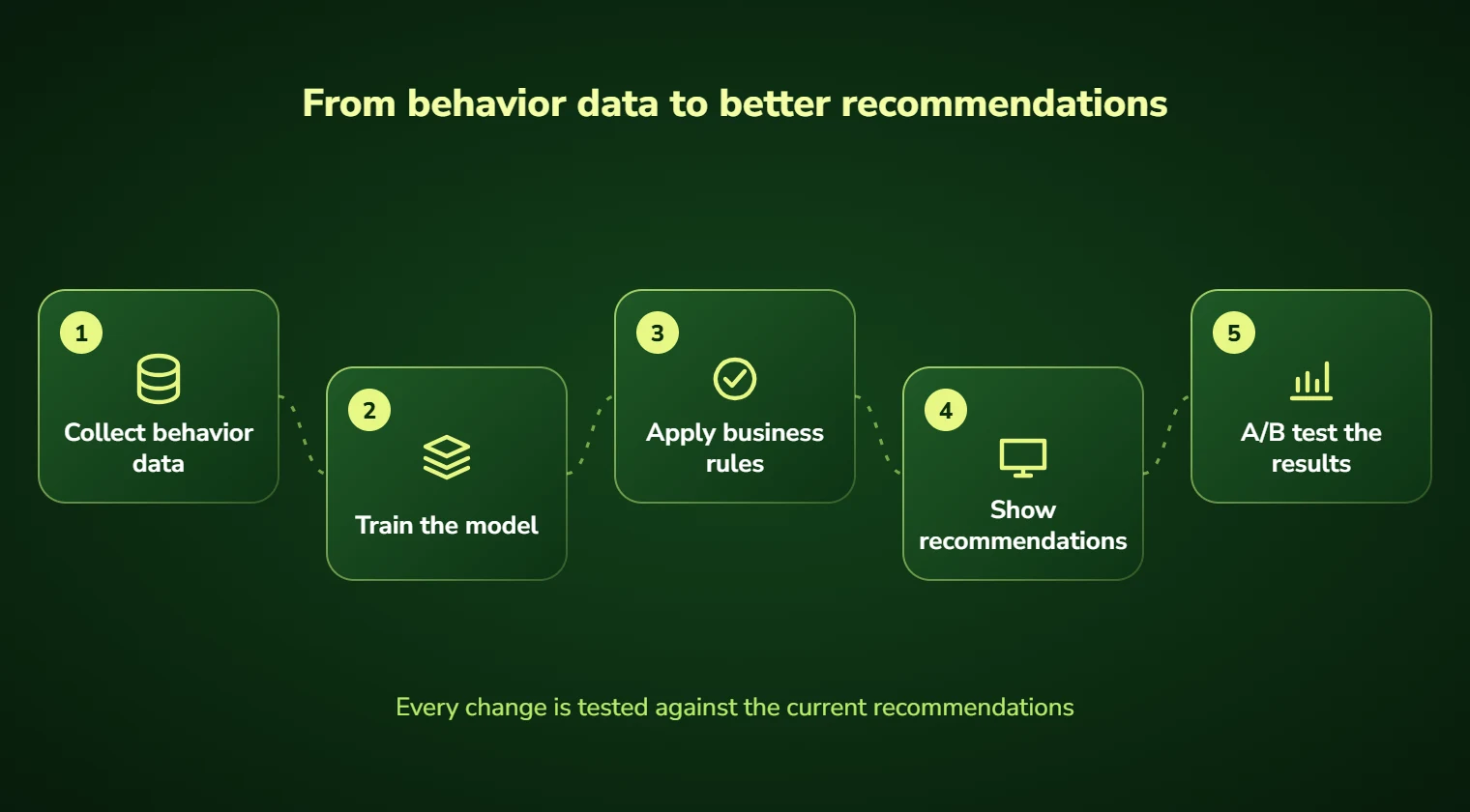
We build with a permanent holdout group that never sees recommendations, so incremental uplift can be measured rather than inferred. The number is smaller than the attributed one and it is real.

That discipline also makes iteration meaningful: a change to the algorithm can be evaluated against actual incremental effect rather than against a metric that moves for other reasons.

Analytics illustration
Conceptual analytics illustration
Service Overview

Recommendation system development: scope and deliverables

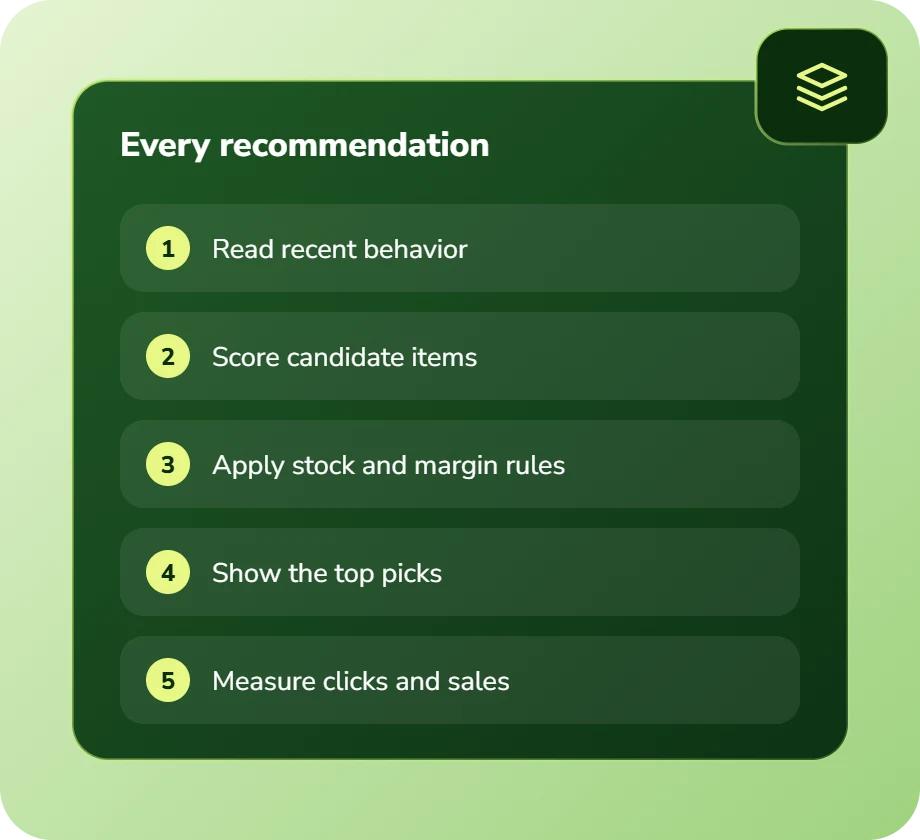
Candidate generation comes first: narrowing millions of items to a few hundred plausible ones quickly, usually with embeddings and approximate nearest neighbour search.

Then ranking: ordering candidates by predicted relevance using behavioural signals, item features and business rules. Business rules matter more than most technical write-ups suggest: margin, stock and strategic priority all belong in the ranking.

The cold start problem needs explicit handling. New users and new items have no behavioural history, and a system that recommends nothing useful to a first-time visitor is failing at the moment of highest opportunity.

  • Candidate generation with embeddings and fast approximate search
  • Ranking combining behavioural signals, item features and business rules
  • Cold start handling for new users and newly added items
  • Diversity and exploration so recommendations do not collapse onto bestsellers
  • Holdout testing infrastructure for honest incremental measurement
  • Real-time serving within your latency budget
Right Fit

Who benefits from recommendations

Platforms with enough catalogue that discovery is genuinely hard, and enough traffic that behavioural signal exists. Below a few thousand items and meaningful traffic, curated merchandising usually beats an algorithm.

And businesses whose existing recommendation platform is expensive, opaque, or producing uplift nobody can verify.

  • Catalogues large enough that discovery is a genuine problem
  • Platforms with sufficient traffic to generate behavioural signal
  • Businesses paying per-transaction fees to a recommendation vendor
  • Companies whose recommendation uplift has never been properly tested
  • Marketplaces needing recommendations across heterogeneous inventory
  • Content platforms where engagement depends on discovery
Benefits

Benefits of recommendation systems

Uplift you can defend

Holdout measurement producing an incremental number that survives scrutiny from a finance team.

Business rules respected

Margin, stock position and strategic priority incorporated into ranking rather than fought against afterwards.

Cold start handled

New visitors and new items get sensible recommendations rather than nothing, which is where opportunity is highest.

No per-transaction fees

Owned infrastructure rather than a vendor taking a percentage of the revenue it claims to have generated.

Diversity maintained

Explicit exploration so recommendations do not collapse onto the same bestsellers for everyone.

Latency within budget

Serving architecture designed for your page load requirements rather than added as an afterthought.

Problems We Solve

Business challenges recommendation systems solve

01

Uplift nobody can verify

Attributed revenue mistaken for incremental. Holdout testing produces a defensible number.

02

Recommendations ignoring margin

Algorithms optimizing revenue against business interest. Business rules built into ranking.

03

Nothing useful for new visitors

Cold start producing empty or generic results. Explicit handling for no-history cases.

04

Everything recommending bestsellers

Feedback loops collapsing diversity. Exploration mechanisms maintain breadth.

05

Vendor fees scaling with revenue

Percentage-of-revenue pricing on unverified uplift. Owned systems have flat cost.

06

Recommendations slowing the page

Latency hurting conversion more than recommendations help. Serving designed to a budget.

What's Included

Recommendation systems features and deliverables

Everything below is in scope on a standard engagement. Nothing here is an upsell discovered halfway through the build.

01

Candidate generation

Embedding-based retrieval narrowing a large catalogue to plausible candidates within a few milliseconds.

02

Ranking models

Relevance ranking combining behavioural signals, item features and explicit business objectives.

03

Business rule layer

Margin, inventory position, strategic priority and exclusion rules applied transparently within ranking.

04

Cold start strategies

Content-based and popularity-based fallbacks for new users and items with no behavioural history.

05

Diversity and exploration

Controlled exploration preventing feedback loops that narrow recommendations to the same items.

06

Holdout infrastructure

Permanent holdout groups and A/B framework for honest incremental uplift measurement.

07

Real-time serving

Low-latency serving architecture sized to your traffic and page performance requirements.

08

Performance reporting

Incremental uplift, coverage, diversity and latency reported together rather than uplift alone.

Technology Stack

Technologies we use for recommendation systems

We are not tied to one vendor. Model and infrastructure choices are made on accuracy, cost per task, latency, and where your data is allowed to live.

Language Models
C
Claude (Anthropic)
G
GPT (OpenAI)
G
Gemini (Google)
L
Llama
M
Mistral
A
Azure OpenAI Service
Vector & Retrieval
P
Pinecone
W
Weaviate
Q
Qdrant
p
pgvector
E
Elasticsearch
A
Amazon OpenSearch
Data & Backend
P
Python
T
TypeScript / Node.js
P
PostgreSQL
S
Snowflake
d
dbt
A
Apache Airflow
Cloud & Infrastructure
A
AWS Bedrock
G
Google Vertex AI
M
Microsoft Azure
D
Docker
K
Kubernetes
T
Terraform
How We Work

Our AI development process

The same five stages on every engagement, so you always know what happens next and what you get at the end of it.

01

Discovery

We interview the people doing the work, map the workflow end to end, and audit the systems and data behind it.

02

AI Strategy

Every opportunity gets scored on cost to build, time to value, and annual savings, then ranked.

03

Pilot Build

We ship the top-ranked automation as a fixed-scope pilot so you see real output before committing further budget.

04

Implementation

Integration with your live systems, staff training, human-in-the-loop review gates, and a documented rollback path.

05

Optimization

Monthly accuracy reviews, prompt and retrieval tuning, and a written report on hours and dollars saved.

Timeline

How long recommendation systems take

A typical first engagement, week by week. Complex integrations and regulated environments extend this, and we say so during discovery rather than after.

Weeks 1 to 2

Discovery and scoping

Process observation, systems audit, data review, and a written estimate of cost and expected saving before anything is built.

Week 3

Design sign-off

Architecture, data handling rules, review thresholds and success measures agreed in writing.

Weeks 4 to 7

Build and integration

Development against your real data, connected to your live systems, with weekly demos rather than a single reveal.

Week 8

Parallel run and testing

The system runs alongside the existing process so accuracy can be compared directly before anyone depends on it.

Weeks 9 to 10

Launch and handover

Cutover with a rollback path, staff training, full documentation, then 30 days of included tuning.

Who We Work With

Industries we deliver recommendation systems for

Retail & E-commerce

Product data enrichment, demand forecasting, support deflection, and personalized merchandising.

SaaS & Technology

AI features inside your product, support deflection, onboarding assistants, and usage analytics.

Education

Enrollment support, content generation, tutoring assistants, and administrative automation.

Professional Services

Proposal drafting, timesheet capture, research synthesis, and client reporting at scale.

Logistics & Supply Chain

Document processing, carrier communication, exception handling, and inventory rebalancing.

Financial Services

Document extraction, reconciliation, KYC support, and audit-ready reporting with full traceability.

Insurance

First-notice-of-loss intake, claims triage, policy Q&A, and fraud signal detection.

Manufacturing

Quality inspection, maintenance prediction, supplier communication, and production scheduling.

Use Cases

Real-world recommendation systems use cases

01

Product recommendations

Related, complementary and personalized product suggestions across product, cart and email.

02

Marketplace discovery

Recommendations across heterogeneous seller inventory with quality and fulfilment signals incorporated.

03

Content recommendations

Article, video or course suggestions driving engagement and completion.

04

Cross-sell in B2B

Complementary product suggestions based on what similar businesses purchased together.

05

Email personalization

Per-recipient item selection for lifecycle and campaign email.

06

Replenishment prediction

Predicting when consumable purchases are due and surfacing them at the right time.

Why DevSolutionsAI

Why choose DevSolutionsAI for recommendation systems

Business case before build

Every recommendation carries an estimated cost, timeline, and annual savings figure. If the math does not work, we say so before you spend.

Vendor-neutral by design

We resell nothing and take no platform commissions. Model and infrastructure choices are made on fit, cost, and your data-residency rules.

Fixed-scope pilots

The first engagement is a defined deliverable at a defined price, not an open-ended retainer that quietly grows each quarter.

Built for handover

You own the code, the prompts, the infrastructure, and the documentation. No lock-in to a proprietary wrapper you cannot leave.

Human-in-the-loop where it counts

Anything customer-facing, clinical, financial, or legal gets a review gate, a confidence threshold, and a logged audit trail.

Security reviewed early

Data flow diagrams, retention rules, and access boundaries are agreed in week one, not retrofitted after your security team objects.

Get Started

Find out what recommendation systems would cost you, before you commit to anything

Every engagement is quoted after a short discovery, so you get a fixed written price built around your actual volumes rather than a rate card that assumes someone else’s business.

The first call is thirty minutes and free. Bring one workflow. We will tell you what it is likely costing you each year, roughly what automating it would take, and whether we think it is worth doing at all.

  • A written savings estimate before any paid work
  • Fixed scope and fixed price, agreed up front
  • Full ownership of everything we build for you
  • An honest recommendation when the numbers do not work
What clients typically see
Across recent projects
Staff hours saved each week
31
Months to payback
4.8
Client retention
94%
Response to enquiries
4 hrs

Figures are internal measurements across recent engagements, reported to every client monthly in writing.

Illustrative project scenario

Illustrative project scenario

Specialty retailer · 180,000 SKUs

A smaller uplift number that the finance team believed

Challenge. A retailer’s vendor recommendation platform reported a large revenue uplift and charged a percentage of attributed revenue accordingly. Finance had never been able to verify the figure, because attribution counted all revenue from sessions touching a recommendation.

What we built. A custom system with a permanent 5% holdout group receiving no recommendations at all, enabling genuine incremental measurement. Ranking incorporated margin and inventory position alongside relevance. Cold start handling used content-based matching for new visitors.

Outcome. Measured incremental uplift was substantially lower than the vendor’s attributed figure, and it was real, verifiable and accepted by finance. Because ranking now accounted for margin, incremental gross profit improved by more than incremental revenue. The percentage-of-revenue vendor fee was eliminated.

5%
Permanent holdout group
Verified
Incremental uplift measured
Margin-aware
Ranking objective
$0
Revenue-share fees

Illustrative project scenario. The figures demonstrate how a project could be scoped and evaluated; they are not verified client results or an audited average.

Client Feedback

What clients say about working with us

31
Avg. staff hours saved weekly
4.8
Avg. months to payback
94%
Client retention
4
Hour response to enquiries
Common Questions

Recommendation Systems FAQs

Less than most vendor case studies claim, because those figures are usually attributed rather than incremental. Attribution counts all revenue from sessions where someone touched a recommendation, including customers who would have found and bought the item anyway. Real incremental uplift measured against a holdout is meaningfully smaller. We will give you a realistic projection during assessment and design the measurement so you can verify it afterwards.

Because without one there is no way to separate revenue the system generated from revenue you would have received regardless. A permanent holdout of a few percent costs very little and is the only way to produce a number that survives scrutiny from a finance team. It also makes iteration meaningful, since algorithm changes can be evaluated on actual incremental effect.

Buy if you want to start quickly and your volume is moderate; vendor platforms are genuinely good and fast to deploy. Build when revenue is high enough that percentage-of-revenue fees become significant, when you need business rules like margin and inventory built into ranking, or when you want uplift you can verify independently. We do the build-versus-buy analysis honestly during assessment.

With explicit cold start strategies rather than leaving them to fail. New items are recommended based on content similarity to existing items rather than waiting for behavioural data. New visitors get popularity and context-based recommendations that improve as the session progresses. First-time visitors are the highest-opportunity moment and the most commonly neglected case.

Yes, and they should. A recommendation system optimizing purely for conversion will push low-margin bestsellers and items you are about to run out of. Business objectives belong in the ranking function explicitly and transparently, rather than being fought against with exclusion lists afterwards. On a recent engagement, margin-aware ranking improved incremental gross profit by more than it improved revenue.
A two-week assessment covering data readiness, realistic uplift projection and build-versus-buy analysis runs $9,000 to $16,000. A production system with candidate generation, ranking, business rules, cold start handling and holdout infrastructure typically runs $65,000 to $140,000 depending on catalogue size and latency requirements.

Service Areas

Recommendation Systems across the United States

We deliver recommendation systems remotely to clients nationwide, with on-site workshops available in major metros.

Ready to scope your recommendation systems project?

Book a free 30-minute consultation. Bring one workflow and leave with a realistic estimate of what it would cost to automate and what it would save.

Free 30-minute consultation
Fixed-scope pilots
U.S.-based team
Custom, not off-the-shelf
SOC 2-aligned practices
ROI tracked in writing
Free 30-minute AI consultation