An AI roadmap should tell leadership what to fund next quarter, what it will cost and how you will know it worked. This guide covers the four-week method we use in discovery, a scoring frame you can copy, a worked example, and the red flags that mean a plan is not ready yet.
Why most AI roadmaps die in committee
The typical AI roadmap is a slide with twelve initiatives grouped into horizons. It fails review because it answers the question “what could we do with AI” when the committee is asking “what should we fund next quarter, and how will we know it worked”.
By contrast, a roadmap that survives is short, ordered, and priced. Specifically, it names the workflow, the current cost, the expected saving, the build cost and the sequence dependency. As a result, three projects specified like that beat twelve described as opportunities.
Committees are not being difficult when they reject the long version. They are responsible for budget, so they need numbers they can compare against every other use of that money. As a result, the format of the plan matters as much as the ideas in it.
Our four-week AI roadmap method
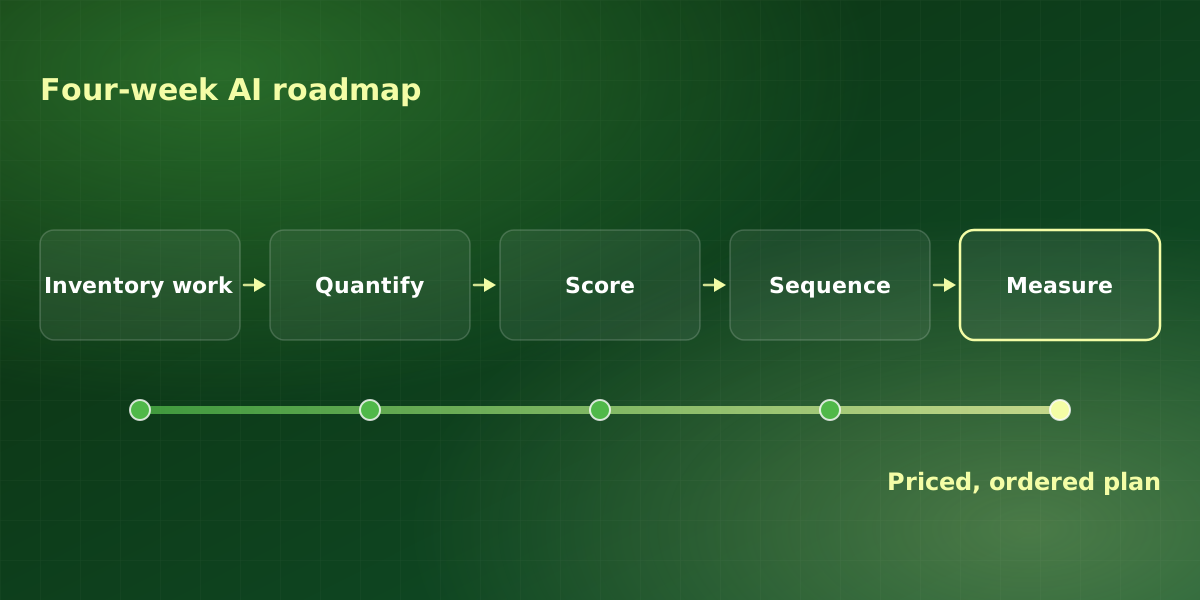
Four weeks, five steps. We run this process in discovery, and it still works whether or not we do the build.
-
Inventory the work, not the technology
Start by interviewing the people doing the job, then map what actually happens, including the workarounds nobody documented. The gap between the official process and the real one is usually where the largest savings hide.
-
Quantify each candidate
Hours per week, people involved, error rate, cost of an error, and volume trend. Anything you cannot quantify goes in a parking list, not the roadmap. As a result, this step eliminates about a third of candidates on its own.
-
Score on effort and payback
Two axes, plotted honestly. Effort accounts for integration count, data condition and compliance surface. Payback, meanwhile, is annual saving divided by build cost. The top-left quadrant, low effort and fast payback, is your first project regardless of which one is most exciting.
-
Sequence the AI roadmap by dependency, not enthusiasm
Some projects unlock others, so order matters. Consolidating product data is dull, and it is often the prerequisite for three downstream automations. Therefore, put the unglamorous enabler first if it shortens everything after it.
-
Attach a measurement plan before building
Define the baseline metric and how you will re-measure it. Do this before the build, because measuring afterwards means arguing about what the baseline was. Our guide to measuring ROI on AI projects also goes deeper on choosing that metric.
A scoring frame that holds up
Score each candidate one to five on these, then sort. Crude, transparent, and far more defensible than intuition.
| Factor | Weight | What a 5 looks like |
|---|---|---|
| Hours saved per week | High | More than 20 across the team |
| Payback period | High | Under 6 months |
| Integration complexity | High | One or two systems, modern APIs |
| Data readiness | Medium | Data exists, structured, accessible |
| Compliance exposure | Medium | No regulated data involved |
| Team appetite | Medium | The people doing it asked for this |
| Reversibility | Low | Easy to switch off without disruption |
Team appetite is weighted higher than most frameworks allow. An automation the affected team wants gets adopted; one imposed on a skeptical team quietly gets bypassed, and you will not find out for two quarters.
When scores tie, we break the tie on data readiness, because a project waiting on a data cleanup slips no matter how strong its business case looks. We also score as a group: the operations lead, a finance partner and the systems owner should all see the same numbers, so nobody disputes the method later.
A worked AI roadmap example
Imagine a hypothetical 40-person distribution company with three candidates on its list:
- Invoice entry. Fifteen hours a week across two people, one accounting system with a modern API and structured data, so it is low effort with fast payback.
- Demand forecasting. Potentially valuable, but sales history sits in three spreadsheets with clashing product codes. That makes it high effort, with uncertain payback.
- Customer email triage. Ten hours a week, one shared inbox and a support team that asked for help, so it is low effort with medium payback.
Then run the payback sums. For instance, at an assumed loaded cost of $40 an hour, fifteen hours a week comes to roughly $31,000 a year. So a build costing $15,000 would pay back in about six months, which earns a 5 on that row.
So, scored honestly, invoice entry goes first and email triage second. Forecasting does not disappear; instead, it waits behind a product-data cleanup that the first two projects never needed. That cleanup then becomes the enabler for quarter two, which is exactly the dependency logic from step four.
Red flags in your own roadmap
If any of these are true, the roadmap is not ready:
- No project has a named owner in the business, only in IT.
- The first project is the most technically interesting one rather than the fastest payback.
- Nothing on the list is a process fix or a report. A roadmap where every answer is AI has not been assessed honestly.
- The baseline metrics are estimates rather than measurements.
- There is no decision point where you would stop. A roadmap without a kill criterion is a wish list.
The third flag deserves extra attention, because it is the easiest to miss. Google’s Rules of Machine Learning makes a similar case for engineering teams: give simple approaches a fair hearing before reaching for complex ones. In other words, a plan that includes a few non-AI fixes is usually more credible, not less.
Keeping your AI roadmap current
A roadmap is a decision tool, so it needs a review rhythm. We therefore suggest a short quarterly session with the business owner of each project, covering four checks:
- Re-measure. Compare each shipped project against its baseline and record the result, good or bad.
- Re-score. Volumes, costs and team appetite change, so score the remaining candidates again rather than trusting last quarter’s numbers.
- Apply the kill criteria. If a project missed its decision point, stop or rescope it. Stopping on schedule is not failure; instead, it shows the process works.
- Check the risk picture. When projects touch more data, revisit compliance exposure. NIST’s AI Risk Management Framework gives that conversation a vendor-neutral structure.
In short, the AI roadmap you approve in January should look a little different by July. That is not drift; rather, it is the plan responding to evidence. We also keep the parking list from step two in the same document, since a candidate that failed on data readiness last quarter may qualify once a cleanup lands.
Frequently asked questions
How long should an AI roadmap cover?
Should we hire internally or use a consultancy?
What if we have no clean data?
How much should we budget for a roadmap engagement?
Who should own the AI roadmap?
For implementation support, explore our AI strategy consulting or discuss your workflow in a free consultation.