Artificial intelligence has become a practical tool for businesses. From automating customer support to managing documents and connecting software systems, AI is helping organizations reduce repetitive work and improve operational efficiency.
Now, a new term is entering the conversation: Super Intelligence (SI).
On September 29, 2026, President Donald Trump signed Executive Order 14434, Inaugurating the Era of Super Intelligence, directing U.S. executive departments and agencies to use “Super Intelligence” and “SI” instead of “Artificial Intelligence” and “AI” in specified official communications.
The announcement has introduced a new terminology question for business owners, technology leaders, and organizations evaluating automation: does Super Intelligence represent a new technology, or is it simply a different name for the AI systems businesses already use?
The answer depends on the context. In the executive order, SI refers to technologies already covered by the federal definition of AI. In scientific research, however, superintelligence traditionally refers to a hypothetical level of intelligence that exceeds human cognitive capabilities.
This guide explains what Super Intelligence means, why the terminology changed, how SI differs from AI and artificial superintelligence (ASI), and what U.S. businesses should do next.
What is super intelligence (SI)?
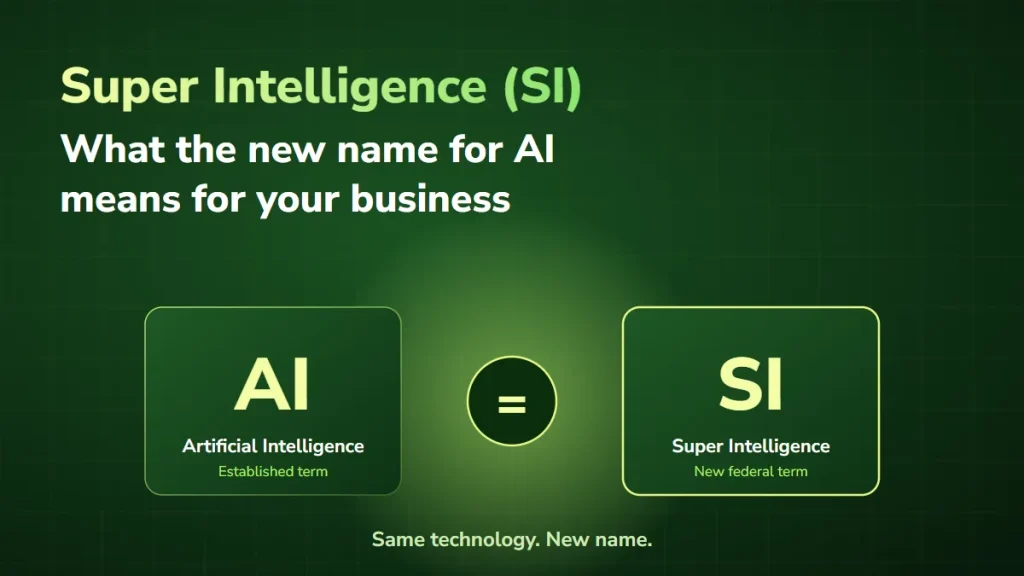
Super Intelligence (SI) is the terminology adopted by the U.S. executive branch for technologies previously described as artificial intelligence (AI), under Executive Order 14434.
For purposes of the order, SI uses the existing federal statutory definition of artificial intelligence in section 9401(3) of title 15, United States Code. That definition covers machine-based systems that can make predictions, recommendations, or decisions influencing real or virtual environments based on human-defined objectives.
In practical terms, the super intelligence meaning in this context can encompass technologies such as:
- AI-powered customer support systems.
- Machine learning and predictive analytics.
- Intelligent document processing.
- AI agents and workflow automation.
- Generative AI applications.
- Business software using AI-driven recommendations.
The change does not mean these systems have suddenly developed intelligence beyond human capabilities. Instead, it reflects a federal terminology policy intended to emphasize the capabilities and potential of modern intelligent technology.
Why is artificial intelligence being called super intelligence?
The September 2026 executive order argues that the term artificial intelligence no longer adequately reflects the growing capabilities of advanced systems. The administration’s position is that modern AI increasingly does more than imitate isolated aspects of human intelligence: it can support creativity, scientific research, complex problem-solving, and new forms of productivity.
The order therefore directs executive agencies, to the extent permitted by law, to use the term Super Intelligence in official correspondence, public communications, websites, reports, policy documents, and other non-statutory documents.
However, this is a U.S. executive-branch terminology change, not a universal renaming of artificial intelligence across the technology industry. Businesses, researchers, software providers, and international organizations may continue using AI as their primary term.
Super intelligence vs. artificial intelligence: what’s the difference?
The distinction between AI vs. SI depends on whether the terms are being used in a federal policy context or a technical research context.
| Feature | Artificial intelligence (AI) | Super intelligence (SI) |
|---|---|---|
| Meaning | Broad field of intelligent computer systems | New U.S. executive-branch terminology for AI |
| Technology | Machine learning, generative AI, intelligent agents, automation | The same technologies under the current federal definition |
| Business applications | Customer support, sales, analytics, workflow automation | The same applications |
| Technical capability | Depends on the system | No additional capability implied by the name |
| Industry adoption | Widely established | Emerging federal terminology |
| Legal implications | Used in existing laws and contracts | Used in specified executive-branch communications |
| Business impact | Existing technology investments and opportunities | Possible terminology changes in government-facing materials |
Does SI replace AI everywhere?
No. Executive Order 14434 applies to federal executive departments and agencies, subject to applicable law. It does not automatically require private businesses to rename their AI products, websites, marketing materials, or internal systems.
The order also states that nothing in it requires changes to previously issued regulations, presidential actions, contracts, grants, or other historical documents.
For businesses serving federal agencies, the terminology may become increasingly relevant in procurement documents, agency communications, and government-related projects. For other businesses, understanding both terms is useful, but there is no general requirement to abandon the established term AI.
Is super intelligence (SI) the same as artificial superintelligence (ASI)?
No. This is one of the most important distinctions for businesses to understand.
Super Intelligence (SI), as used in the 2026 executive order, is a policy term referring to existing AI technologies. Artificial superintelligence (ASI) is a technical concept describing a hypothetical AI system that would substantially exceed human intelligence across virtually every intellectual domain.
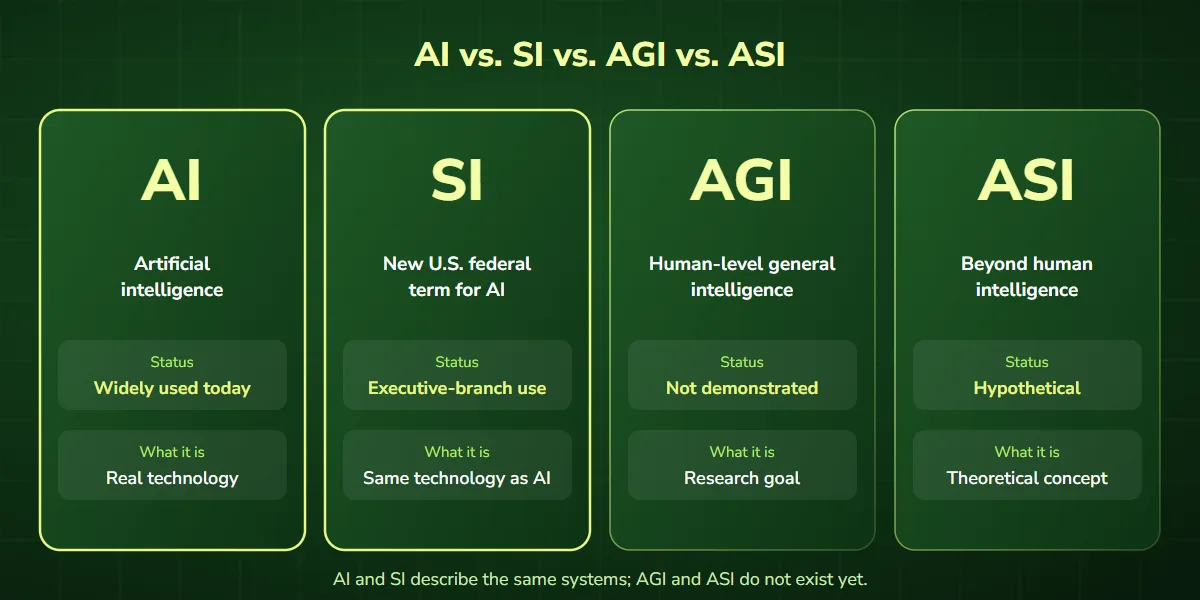
AI vs. SI vs. AGI vs. ASI
| Term | Meaning | Current status |
|---|---|---|
| AI | Artificial intelligence | Widely used today |
| SI | New U.S. federal terminology for AI | Adopted in executive-branch communications |
| AGI | Artificial general intelligence: broadly human-level general cognitive capability | No universally accepted demonstration |
| ASI | Artificial superintelligence: intelligence substantially beyond human capabilities | Hypothetical |
A business using an AI chatbot, for example, does not suddenly possess artificial superintelligence because a government document refers to that technology as SI. The system’s capabilities, limitations, reliability, and operational requirements remain the same.
For a deeper look at intelligence levels, read our guide to artificial superintelligence vs super intelligence and how AI, AGI, and ASI compare.
What does the new SI terminology mean for U.S. businesses?
For most U.S. businesses, the immediate impact is primarily about terminology, communication, and future policy developments rather than replacing existing technology. However, there are several areas worth monitoring.
1. Government communications and procurement
Businesses that work with federal agencies may begin encountering Super Intelligence or SI in new official documents, including procurement notices, technical requirements, policy communications, and program descriptions.
SI may refer to the same broad technology category previously described as AI. Before responding to a government opportunity, review the specific definitions and requirements in the relevant documents.
2. Business marketing and SEO
The terminology change creates an additional topic that technology companies may need to explain to their audiences. However, established search terms such as AI automation, AI consulting, and AI agents remain useful descriptions of existing services.
Businesses should not automatically replace all references to AI with SI. Instead, they can publish educational content explaining the new terminology while continuing to use established, relevant search terms. For example, a business might explain that its AI automation services fall within the technologies described as SI in the new federal terminology.
This approach supports clarity without implying that ordinary automation software possesses hypothetical superhuman intelligence.
3. Vendor evaluation and technology purchasing
As SI appears in more communications, technology vendors may begin using the term in product descriptions. Business buyers should focus on demonstrated capabilities rather than labels.
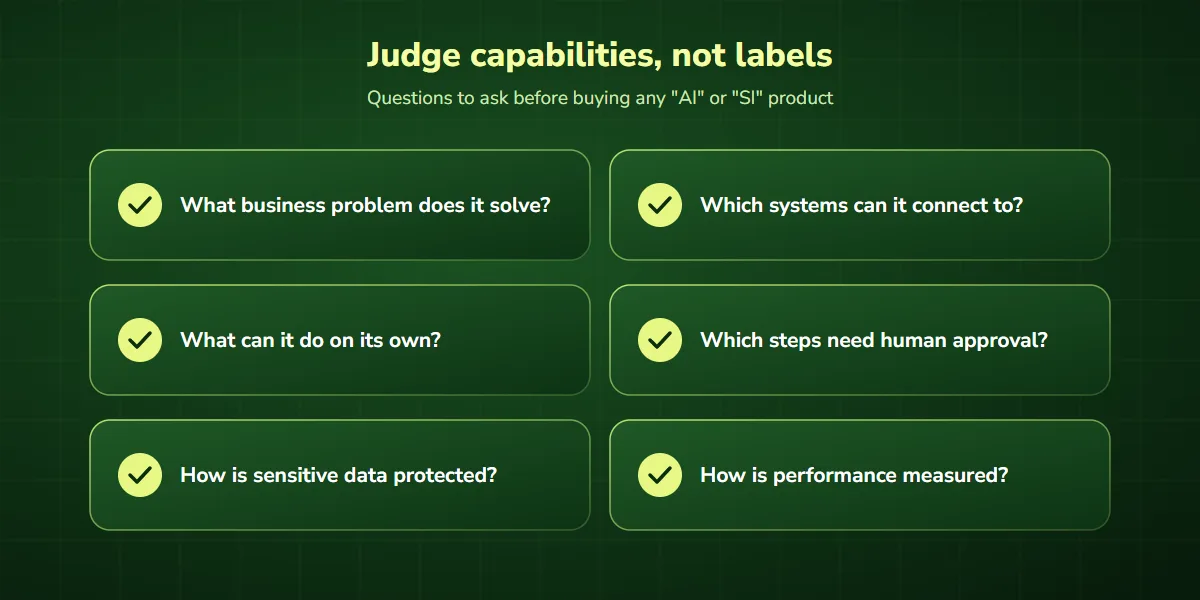
Before purchasing an intelligent automation solution, ask:
- What specific business problem does the system solve?
- Which applications and databases can it connect to?
- What actions can it perform independently?
- What human approvals are required?
- How is sensitive information protected?
- How is performance measured?
- What happens when the system produces an incorrect result?
A product labeled SI is not necessarily more capable than one labeled AI.
4. Internal policies and documentation
Businesses do not generally need to rewrite their internal AI policies simply because of the executive order. However, organizations operating in regulated environments or working with federal agencies should review relevant terminology when updating documents. Clear definitions help employees, vendors, and clients understand which technologies a policy covers.
How can businesses use super intelligence technologies today?
Under the federal terminology, SI encompasses existing AI technologies that businesses can already deploy. The most valuable applications of AI automation for business are often those addressing repetitive work, disconnected software, and time-consuming operational processes.
Customer support automation
Businesses can use intelligent systems to classify inquiries, retrieve approved information, draft responses, and route complex cases to employees. For example, a service company might receive customer requests through email, website forms, and messaging channels. Instead of manually assigning every request, an AI-assisted workflow can categorize the inquiry and direct it to the appropriate team.
Explore customer support AI solutions to understand how these workflows can be implemented.
Sales and CRM automation
Sales teams frequently spend time updating records, organizing leads, and preparing follow-up communications. Intelligent automation can help:
- Capture incoming leads.
- Identify missing customer information.
- Update CRM records.
- Prepare personalized follow-up drafts.
- Route qualified opportunities to sales representatives.
These capabilities can support faster follow-up and reduce repetitive administrative work. Learn more about CRM automation.
Document processing
Organizations regularly process invoices, forms, contracts, and other documents. AI-powered document workflows can extract information, classify files, identify missing fields, and flag exceptions for review. For example, an accounting team could use document automation to extract invoice details and prepare records for approval.
Explore Document AI services.
AI agents and connected workflows
AI agents can support workflows that involve multiple steps, tools, and decisions. For example, an agent could retrieve customer information, check the status of a request, prepare an update, and record the interaction in a connected CRM. The level of autonomy should depend on the workflow’s risk, permissions, and required human oversight.
Explore AI agent development to understand suitable use cases.
Real-world business scenario: automating customer requests
Consider a growing U.S. service business receiving 200 customer requests per week. Its employees manually review incoming messages, categorize them, look up customer information, and assign requests to the appropriate department. This creates repetitive work and can delay responses.
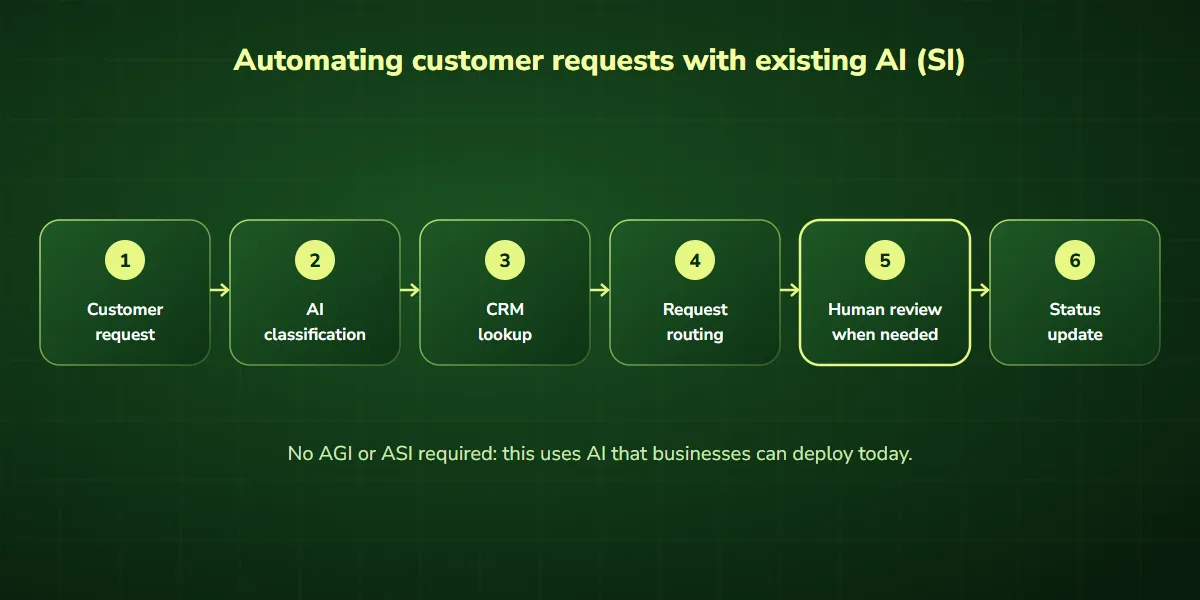
An AI-assisted workflow could follow this process: customer request, AI classification, CRM lookup, request routing, human review when needed, and a status update. The workflow could help the company:
- Reduce manual request categorization.
- Route inquiries more consistently.
- Retrieve customer information from connected systems.
- Prepare responses using approved knowledge.
- Track outcomes through operational reporting.
The actual benefits would need to be measured against the company’s existing process. Importantly, this workflow does not require artificial general intelligence or artificial superintelligence. It uses existing AI technologies, which fall within the new federal SI terminology.
Should businesses rebrand their AI services as SI services?
For most businesses, a complete rebrand is unnecessary. The new terminology may influence government communications and some industry discussions, but artificial intelligence remains an established technical and commercial term. Organizations should prioritize language that their customers understand.
A practical content strategy might include:
- Maintaining established AI service-page terminology.
- Publishing a dedicated explanation of Super Intelligence.
- Clarifying the difference between SI and ASI.
- Monitoring terminology changes in government guidance.
- Updating documentation when specific legal or commercial requirements justify it.
This approach avoids confusing customers or making unsupported claims about technological capabilities.
How to prepare your business for the future of SI and AI
Whether technology providers use AI or SI terminology, the business objective remains the same: identify valuable applications and deploy them responsibly.
Step 1: Audit existing business processes
Identify workflows involving repetitive tasks, manual data entry, disconnected systems, and frequent handoffs. Prioritize processes where improvements can be measured.
Step 2: Select a practical use case
Choose an automation opportunity with clear boundaries, such as customer request classification, invoice data extraction, appointment scheduling, or CRM updates.
Step 3: Review your technology infrastructure
Determine which applications, databases, and APIs are needed to support the workflow. Reliable integration is often essential for automation success.
Step 4: Establish security and human oversight
Define access permissions, approval requirements, exception handling, and data protection controls. The NIST AI Risk Management Framework offers useful guidance for evaluating and managing AI-related risks.
Step 5: Measure business outcomes
Track performance using metrics such as processing time, error rates, cost per transaction, response time, and employee hours spent on repetitive tasks.
Step 6: Monitor policy and terminology changes
The executive order directs the Assistant to the President for Science and Technology to submit proposed legislative language for a federal SI definition within 60 days. Businesses working with federal agencies should monitor subsequent developments and evaluate whether they affect procurement, compliance, or contractual requirements.
Frequently asked questions about super intelligence (SI)
What does SI stand for in technology?
SI stands for Super Intelligence in the terminology adopted by the U.S. executive branch under Executive Order 14434. In this context, it refers to technologies covered by the existing federal definition of artificial intelligence.
Why did the U.S. government rename AI to SI?
The administration stated that Super Intelligence better reflects the advanced capabilities and potential of modern intelligent systems. The terminology change was established through an executive order signed September 29, 2026.
Is SI more powerful than AI?
Not necessarily. Under the executive order, SI and AI refer to the same category of technologies. The new name does not establish that a system has greater intelligence or performance.
Does the SI executive order affect private businesses?
The order primarily governs terminology used by federal executive agencies. Private businesses are not generally required to rename their AI products or services, although federal contractors may encounter SI terminology in government communications.
Is SI the same as AGI?
No. Artificial general intelligence refers to a proposed level of broad, human-like cognitive capability. SI, in the new federal policy context, refers to existing AI technologies.
Is super intelligence the same as artificial superintelligence?
No. The federal term Super Intelligence uses the existing AI definition. Artificial superintelligence describes a hypothetical system with intellectual capabilities substantially beyond human performance.
Should businesses stop using the term artificial intelligence?
No. Businesses can continue using AI in their services, marketing, and internal communications. They should adopt terminology appropriate to their customers, contracts, and applicable requirements.
Can small businesses benefit from SI technologies?
Yes. Because the federal SI terminology covers existing AI technologies, small businesses can benefit from applications such as workflow automation, customer support tools, CRM integrations, and document processing.
Final thoughts: the name is changing, but business value still matters
The introduction of Super Intelligence (SI) into U.S. federal terminology marks a change in how the executive branch communicates about intelligent technology. However, it does not mean that today’s AI systems have automatically become more capable or that businesses need to replace their existing technology.
For business owners, the most important questions remain practical. Which processes consume unnecessary time? Where do employees repeat the same work? Which systems need better integration? How can intelligent automation improve measurable business outcomes? The answers matter more than the terminology.
Organizations that focus on clear use cases, responsible implementation, and measurable results can benefit from existing AI capabilities while staying informed about the future of AI.
Explore practical AI automation with DevSolutionsAI
At DevSolutionsAI, we help U.S. businesses identify automation opportunities, connect existing software, and develop AI-powered workflows that support more efficient operations. Whether the technology is described as artificial intelligence or Super Intelligence in a particular context, our focus remains on solving real business problems.
Book a free 1-on-1 consultation to discuss how intelligent automation could support your business.