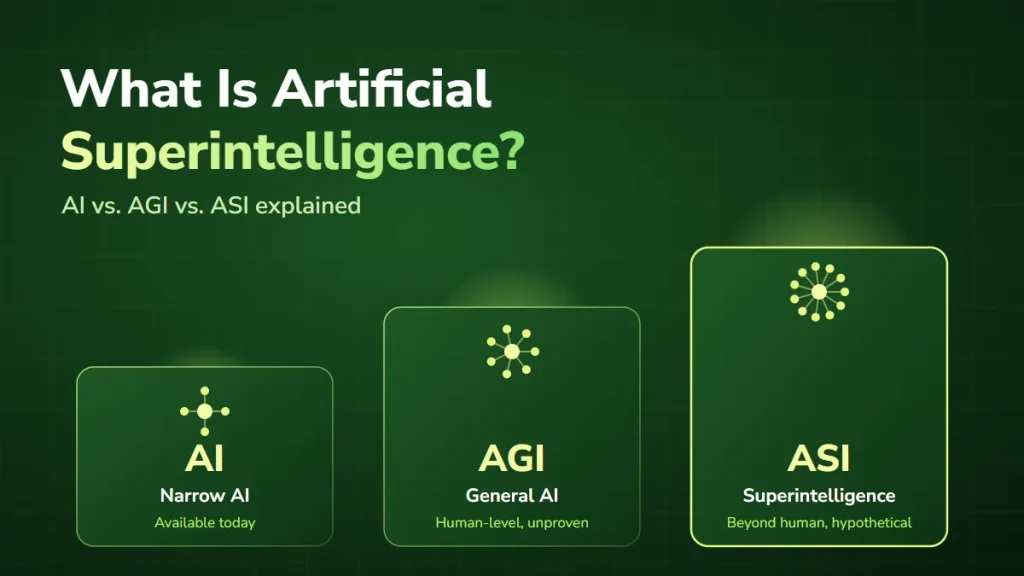
Artificial intelligence is changing how businesses operate, from automating repetitive tasks to improving customer support and analyzing complex information. But as AI technology advances, a bigger question is emerging: what happens when machines become more intelligent than humans?
This possibility is known as artificial superintelligence (ASI), a theoretical form of AI that could surpass human intellectual capabilities across virtually every cognitive field.
Understanding artificial superintelligence also means understanding two related concepts: artificial intelligence (AI) and artificial general intelligence (AGI). Although these terms are sometimes used interchangeably, they describe different levels of machine capability.
In this guide, we explain what artificial superintelligence means, how AI vs. AGI vs. ASI compares, potential applications, major risks, and what these developments could mean for businesses.
What is artificial superintelligence (ASI)?
Artificial superintelligence (ASI) is a hypothetical form of artificial intelligence capable of outperforming the best human minds across nearly every intellectual activity, including scientific reasoning, creativity, strategic planning, learning, and problem-solving.
Unlike today’s AI systems, which operate within technological and practical limitations, ASI would theoretically possess capabilities far beyond those of individual humans and potentially human teams. A superintelligent AI might be capable of:
- Solving complex scientific problems beyond current human capabilities.
- Discovering new approaches to medicine, energy, and engineering.
- Processing and connecting knowledge across multiple disciplines.
- Developing innovative solutions to unfamiliar challenges.
- Making highly sophisticated predictions and strategic decisions.
- Improving technological systems at an unprecedented level.
However, artificial superintelligence has not been demonstrated as an existing technology. It remains a subject of research, theoretical analysis, and debate. Organizations should distinguish these possibilities from the practical AI automation services available today.
What is the difference between AI, AGI, and ASI?
The primary difference between AI, AGI, and ASI is the breadth and level of intelligence each term describes. Artificial intelligence is the broad field of building systems that perform tasks associated with intelligence. Artificial general intelligence describes human-level general cognitive capabilities, while artificial superintelligence refers to intelligence that substantially exceeds human capabilities.
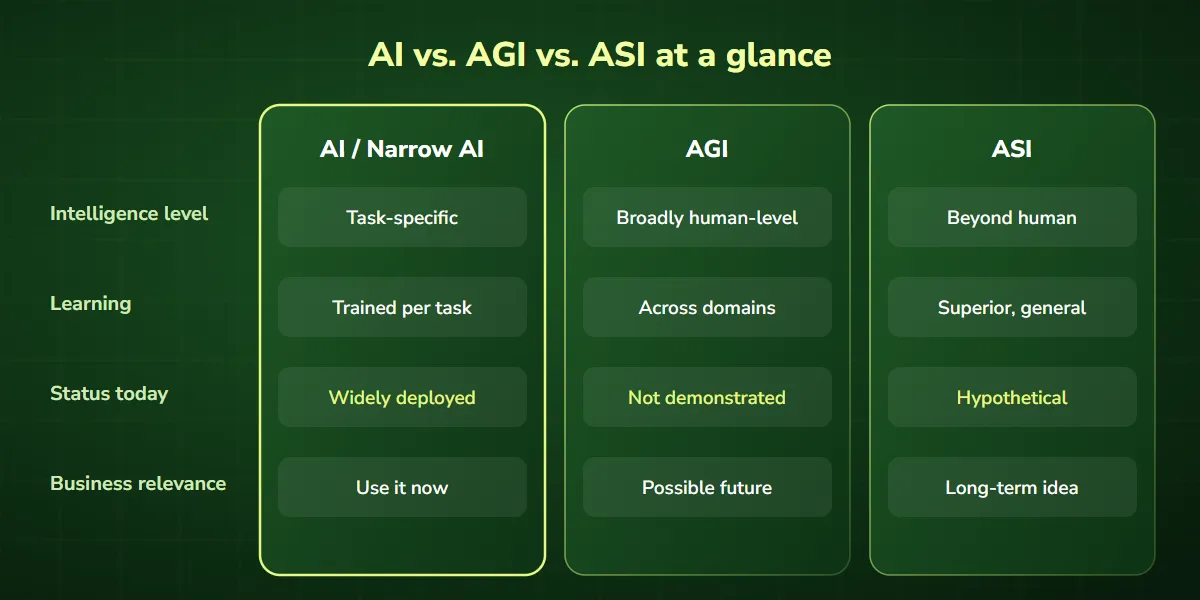
AI vs. AGI vs. ASI comparison
| Feature | AI / narrow AI | AGI | ASI |
|---|---|---|---|
| Meaning | Artificial intelligence | Artificial general intelligence | Artificial superintelligence |
| Intelligence level | Task-specific or bounded capabilities | Broadly human-level | Beyond human-level |
| Learning ability | Varies by system and training | General learning across domains | Hypothetically superior general learning |
| Problem-solving | Within demonstrated capabilities | Across diverse unfamiliar tasks | Potentially beyond human expertise |
| Human supervision | Depends on application | Would depend on design | Would require advanced oversight approaches |
| Current status | Widely deployed | No universally accepted demonstration | Hypothetical |
| Business relevance | Available today | Potential future applications | Long-term possibilities |
These categories are useful for understanding AI development, but they are not universally agreed-upon technical milestones.
1. Artificial intelligence (AI): technology businesses use today
Artificial intelligence, often called narrow AI, enables computer systems to perform tasks such as understanding language, recognizing patterns, generating content, making predictions, and supporting decisions. Modern AI can assist businesses with:
- Customer support chatbots.
- Document classification and data extraction.
- Lead qualification and follow-up.
- Sales forecasting.
- Email and workflow automation.
- Knowledge-base search.
- Operational reporting.
For example, an AI-powered customer support system can classify incoming requests, identify relevant knowledge-base articles, and route difficult cases to human representatives. This can improve workflow efficiency without requiring human-level general intelligence.
2. Artificial general intelligence (AGI): human-level general intelligence
Artificial general intelligence refers to a proposed AI system capable of learning, reasoning, and adapting across a wide variety of intellectual tasks at approximately human-level proficiency or beyond. Unlike specialized AI, AGI would not be restricted to a narrow set of demonstrated capabilities. A hypothetical AGI could potentially:
- Learn unfamiliar tasks with limited additional instruction.
- Apply knowledge from one discipline to another.
- Reason through complex, changing situations.
- Adapt to new environments.
- Perform diverse cognitive tasks without requiring separate specialized systems.
For example, an AGI might analyze a company’s operational challenges, learn unfamiliar business processes, develop solutions, and adapt its approach as circumstances change. However, there is no universally accepted test or threshold for declaring that AGI has been achieved. Researchers continue to debate how general intelligence should be defined, evaluated, and measured.
3. Artificial superintelligence (ASI): beyond human intelligence
Artificial superintelligence goes further than AGI. Rather than simply matching human capabilities, an ASI system would theoretically exceed human performance across a broad range of intellectual activities.
For example, a hypothetical ASI might analyze enormous scientific datasets, identify previously unknown relationships, and develop discoveries beyond the capabilities of existing research teams. The important distinction is that these examples describe potential future capabilities, not proven applications.
How could artificial superintelligence work?
There is no established architecture for building artificial superintelligence. However, researchers discuss several technological capabilities that might contribute to increasingly advanced AI systems.
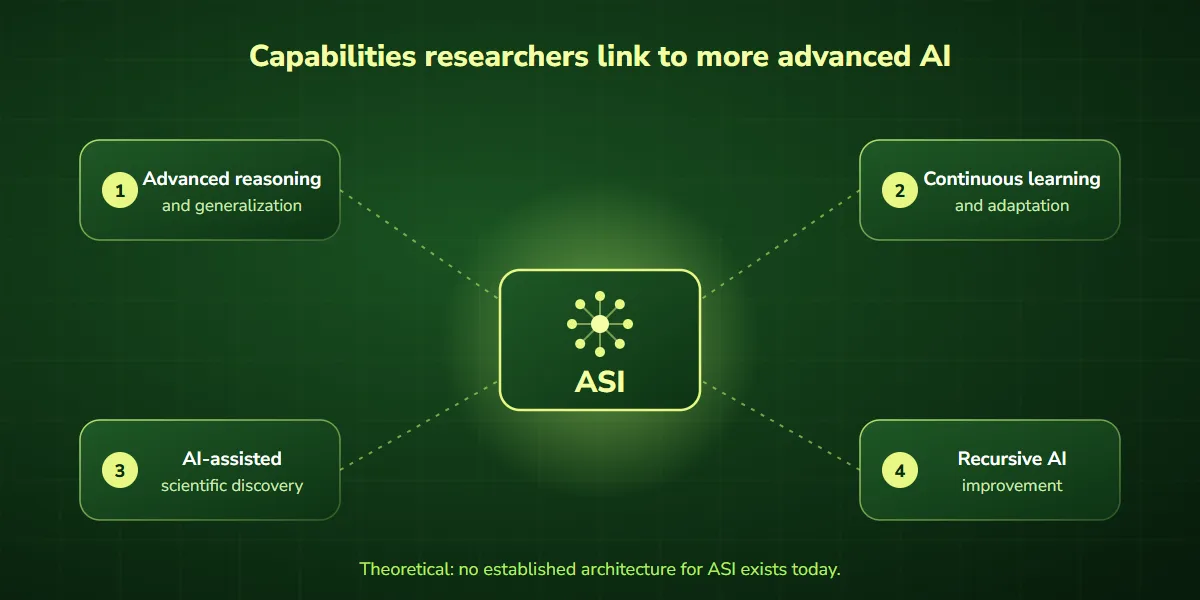
Advanced reasoning and generalization
Future AI systems would need to reason effectively across unfamiliar problems, combine knowledge from different disciplines, and produce reliable solutions under changing conditions. Performance on individual benchmarks would not be sufficient to demonstrate superintelligence.
Continuous learning and adaptation
An advanced system might need to incorporate new information, adapt to unexpected environments, and improve performance without extensive retraining for every new task. Learning effectively would also require mechanisms to prevent errors, harmful behavior, and unreliable conclusions.
AI-assisted scientific discovery
Increasingly capable AI could support scientific research by generating hypotheses, analyzing evidence, and proposing experiments. For superintelligence, these abilities would hypothetically extend beyond the combined intellectual capabilities of human experts.
Recursive AI improvement
One theoretical possibility involves AI systems contributing to the development of more capable AI systems. This is sometimes called recursive self-improvement. However, improvements in AI development do not necessarily imply unlimited intelligence growth. Computational resources, physical constraints, evaluation challenges, and safety requirements could limit progress.
What are potential examples of artificial superintelligence?
Because ASI does not currently exist as a verified, deployed technology, the following artificial superintelligence examples are hypothetical scenarios rather than real-world case studies.
Healthcare and medical research
An artificial superintelligence might accelerate the identification of drug candidates, analyze complex biological systems, and suggest new approaches to treating diseases. Any proposed treatment would still require appropriate scientific validation, clinical trials, and regulatory review.
Scientific research and engineering
ASI could theoretically help researchers investigate difficult scientific questions, develop advanced materials, or discover more efficient energy technologies. Its potential value would depend on whether its predictions could be independently tested and verified.
Business strategy and operations
A hypothetical superintelligent system might evaluate supply chains, market conditions, financial constraints, customer demand, and operational risks simultaneously. It could then recommend strategies based on complex relationships that human teams might struggle to identify.
However, businesses do not need ASI to improve operational efficiency. Existing AI automation can already assist with defined processes and decisions.
Cybersecurity
Future advanced AI might identify complex security vulnerabilities and recommend defensive strategies. The same capabilities could also create significant security risks if used maliciously or deployed without adequate safeguards.
What are the potential benefits of artificial superintelligence?
If developed and governed responsibly, artificial superintelligence could potentially contribute to major advances in several areas:
- Scientific acceleration: more sophisticated reasoning could help researchers investigate difficult problems and identify promising discoveries.
- Improved decision support: advanced systems might evaluate complex information and generate more comprehensive recommendations.
- Technological innovation: ASI could potentially support breakthroughs in computing, engineering, manufacturing, and energy.
- Complex problem-solving: highly capable AI might help analyze challenges involving interconnected economic, environmental, and technological systems.
- Productivity improvements: advanced intelligence could eventually change how organizations design products, manage operations, and allocate resources.
These outcomes are possibilities, not guaranteed benefits. Their realization would depend on technical feasibility, reliability, safety, governance, and real-world deployment.
What are the risks and limitations of artificial superintelligence?
The potential power of artificial superintelligence also raises important safety and governance questions.
AI alignment and control
One of the central challenges is ensuring that advanced AI systems pursue goals consistent with human intentions and constraints. A system capable of making complex decisions could create serious problems if its objectives were poorly specified or if its behavior could not be effectively controlled.
Transparency and explainability
As AI systems become more sophisticated, understanding why they produce particular recommendations may become increasingly difficult. For businesses, explainability is particularly important when AI influences financial, legal, operational, or safety-related decisions.
Cybersecurity and misuse
Highly capable AI could potentially enable more sophisticated cyberattacks, manipulation, or other harmful activities. Strong access controls, monitoring, security testing, and governance would therefore remain essential.
Economic and workforce disruption
Advanced AI could reshape employment, organizational structures, and demand for different skills. The extent of these changes remains uncertain and would depend on adoption patterns, policy decisions, and economic conditions.
Concentration of power
If highly advanced AI capabilities were controlled by a small number of organizations or governments, concerns could arise around accountability, access, competition, and decision-making power.
These risks of artificial superintelligence reinforce the importance of responsible AI development rather than assuming that greater intelligence automatically produces better outcomes.
Is artificial superintelligence possible today?
No publicly verified artificial superintelligence system has been established as of October 2026.
Current AI systems have made substantial progress in language understanding, software development, image analysis, reasoning, and automation. However, strong performance across selected tasks does not demonstrate intelligence that surpasses humanity across virtually every intellectual domain. AGI and ASI also lack universally accepted evaluation standards.
Google DeepMind researchers have proposed assessing AI progress through different levels of performance, generality, and autonomy rather than relying on a single intelligence label. This distinction matters because claims about achieving AGI or ASI should be evaluated using evidence, not marketing terminology.
What does artificial superintelligence mean for businesses?
For most organizations, the immediate opportunity is not implementing artificial superintelligence. It is identifying where today’s AI technology can improve measurable business outcomes. Companies can prepare for increasingly capable AI by building reliable data systems, improving workflows, and establishing appropriate governance.
Step 1: Identify repetitive business processes
Start by reviewing processes that involve frequent manual work, predictable rules, and measurable outcomes. Potential opportunities include customer request routing, CRM updates, document processing, appointment scheduling, and reporting.
Step 2: Evaluate existing AI capabilities
Determine whether current AI tools can address the problem. For example, an AI agent may retrieve approved business information, draft responses, or interact with connected software under defined permissions. Explore AI agent development to understand how task-oriented AI systems can support business workflows.
Step 3: Connect business systems
Many automation opportunities depend on integrating existing tools rather than replacing them. Connecting CRM platforms, databases, communication tools, and internal applications can reduce duplicate work and improve information flow. Businesses can explore AI integration services to assess these opportunities.
Step 4: Establish human oversight
Define which actions AI can perform independently and which require human approval. High-impact decisions, sensitive information, and exceptional situations should receive appropriate safeguards. The National Institute of Standards and Technology provides an AI Risk Management Framework that organizations can use to assess reliability, security, transparency, and accountability.
Step 5: Measure business results
Evaluate AI projects against practical performance indicators such as:
- Time saved per workflow.
- Processing cost per transaction.
- Error and rework rates.
- Customer response time.
- Human escalation frequency.
- Qualified leads generated.
This approach helps businesses evaluate real operational value rather than investing based solely on predictions about future AI capabilities.
Practical example: AI automation in customer support
Consider a business receiving hundreds of customer inquiries across email, website forms, and support channels. Without automation, employees may manually read messages, identify the issue, search for information, and assign each request.
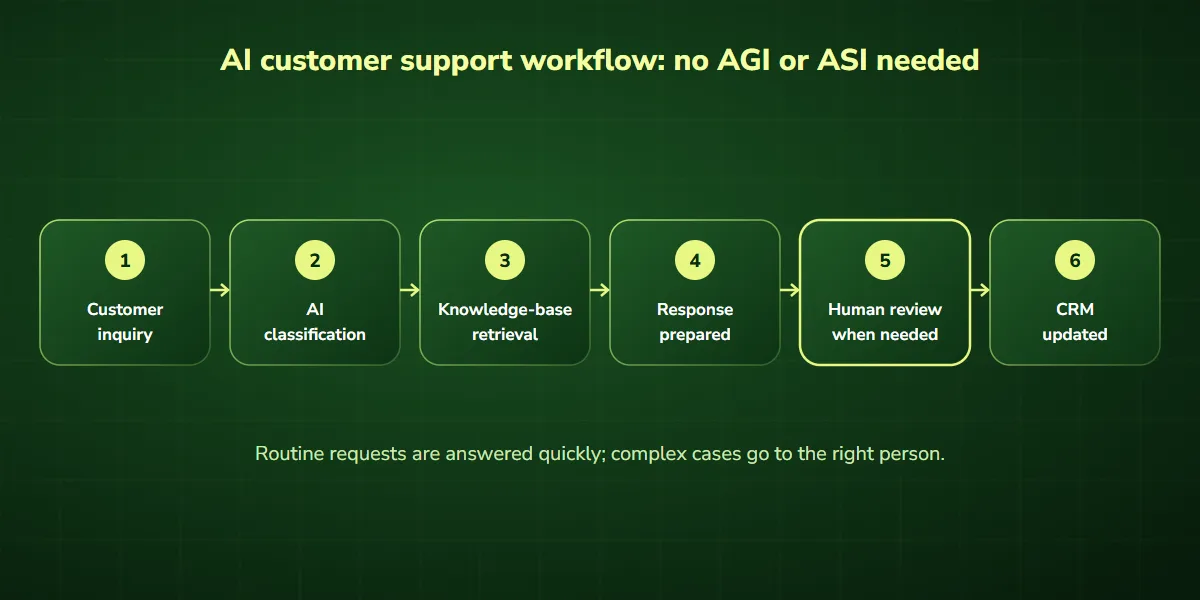
An AI-assisted workflow could operate as follows: customer inquiry, AI classification, knowledge-base retrieval, response preparation, human review when required, and a CRM update. The system could automatically categorize requests, retrieve relevant approved information, and prepare responses for routine issues. More complex cases could be escalated to the appropriate employee.
This example does not require AGI or ASI. It demonstrates how existing AI capabilities can create practical business value through carefully designed workflows. Learn how customer support AI can support this type of process.
How should businesses prepare for the future of AI?
Rather than waiting for artificial general intelligence or artificial superintelligence, organizations can build a foundation that supports future technological improvements. A practical preparation checklist includes:
- Identify processes suitable for automation.
- Improve data quality and system accessibility.
- Document workflows and approval requirements.
- Introduce AI into low-risk, measurable use cases.
- Establish privacy and cybersecurity safeguards.
- Train employees to work effectively with AI tools.
- Monitor performance and review errors.
- Reevaluate AI capabilities as technology develops.
Businesses that develop these foundations may be better positioned to evaluate and adopt more capable AI systems when appropriate. The objective should be sustainable operational improvement, not adopting technology simply because it is new. If you are unsure where to start, AI consulting can help you prioritize.
Frequently asked questions about artificial superintelligence
What does ASI stand for in artificial intelligence?
ASI stands for artificial superintelligence. The ASI meaning is a hypothetical AI system capable of exceeding human intellectual performance across nearly every cognitive domain.
Is artificial superintelligence the same as AGI?
No. Artificial general intelligence generally refers to broad human-level cognitive capabilities, while artificial superintelligence describes intelligence substantially beyond human capabilities.
Does artificial superintelligence exist today?
There is no publicly verified artificial superintelligence system as of October 2026. ASI remains a theoretical concept.
Can ChatGPT be considered artificial superintelligence?
No. ChatGPT and other contemporary AI assistants can perform many sophisticated tasks, but this does not establish superhuman general intelligence across all cognitive domains.
Is agentic AI the same as AGI?
No. Agentic AI describes systems that can plan and execute tasks using tools and workflows. AGI refers to broad, human-level general intelligence. An AI agent does not need AGI to perform useful business tasks.
Will artificial superintelligence replace human workers?
The workforce effects of hypothetical ASI cannot be predicted reliably. Existing AI is already changing some tasks and roles, but future employment outcomes will depend on technological capabilities, business adoption, regulation, and economic conditions.
When will artificial superintelligence become available?
There is no scientifically established timeline for ASI. Predictions vary widely, and its eventual development is uncertain.
What is the difference between superintelligence and artificial superintelligence?
Superintelligence is a broader expression that can refer to intelligence beyond ordinary human capabilities, and it is sometimes used as a branding or policy term. Artificial superintelligence (ASI) specifically describes the hypothetical AI capability of surpassing human intelligence across a broad range of cognitive activities. The terms should not automatically be treated as equivalent.
Final thoughts: AI, AGI, and ASI
Artificial intelligence, artificial general intelligence, and artificial superintelligence represent different concepts within the development of intelligent technology. AI already supports business operations through automation, analytics, customer service, and connected workflows. AGI describes a proposed future capability involving broadly human-level intelligence, while ASI represents the possibility of intelligence substantially beyond human abilities.
Although artificial superintelligence could potentially transform science, technology, and business, the future of AI at that level remains uncertain. For organizations making technology decisions today, the most practical strategy is to focus on AI systems that solve identifiable problems, operate within appropriate safeguards, and deliver measurable value.
Explore practical AI automation with DevSolutionsAI
You do not need to wait for artificial superintelligence to make your business workflows more efficient. At DevSolutionsAI, we help U.S. businesses explore AI automation opportunities, connect existing systems, and develop practical workflows that reduce repetitive work and support better operations.
Whether you want to automate customer support, streamline internal processes, or evaluate AI agents, the first step is identifying a suitable business use case. Book a free 1-on-1 consultation to discuss where AI automation could make a measurable difference in your business.