AI contract review can help legal teams extract clauses and prioritize documents for attention. This guide explains how to scope that first pass while keeping legal judgment, confidentiality and verification with the responsible professionals. It also covers the controls that make the work defensible, a worked example and the step-by-step approach we use on these projects.
Automate the first pass, never the opinion
Legal AI works when it is scoped as triage. Reading a hundred contracts to find the twelve with a problematic indemnity clause is mechanical work that consumes expensive hours. However, deciding what to do about those twelve is legal judgment, and it stays with a lawyer.
Framed that way, the technology is uncontroversial and the return is straightforward. But framed as “AI reviews our contracts”, it becomes a professional responsibility question that will, correctly, stall in committee.
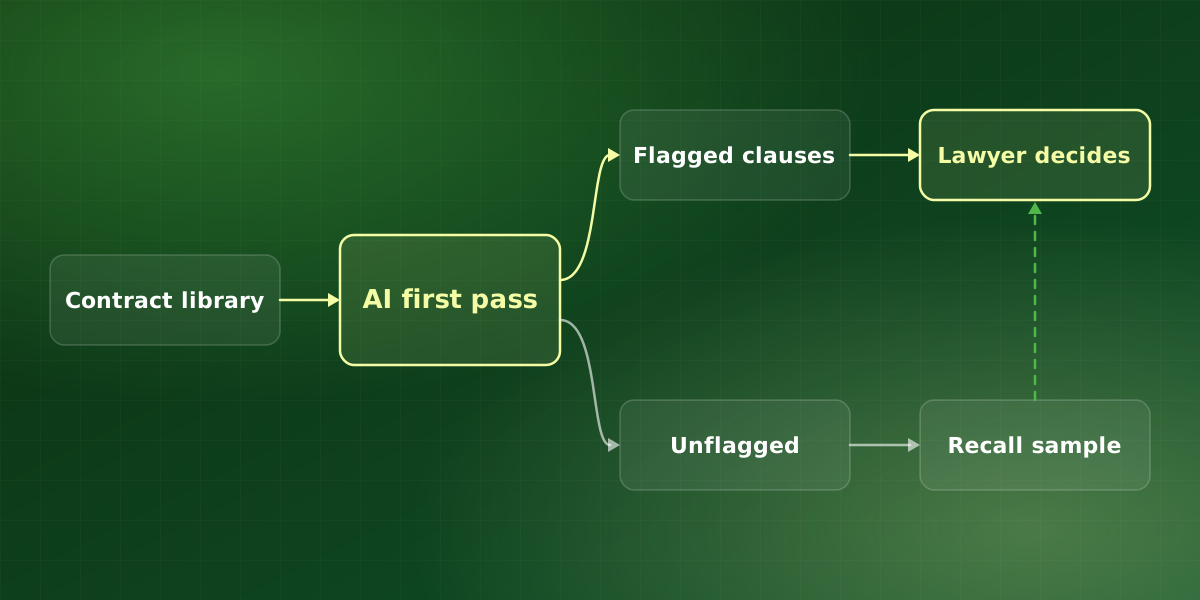
In practice, that means the system reads, extracts and flags, while lawyers decide. So every design choice that follows, from citations to sampling, exists to keep that line clear. Because of that, the project is easier to approve, easier to measure and easier to defend.
Where AI contract review earns its cost
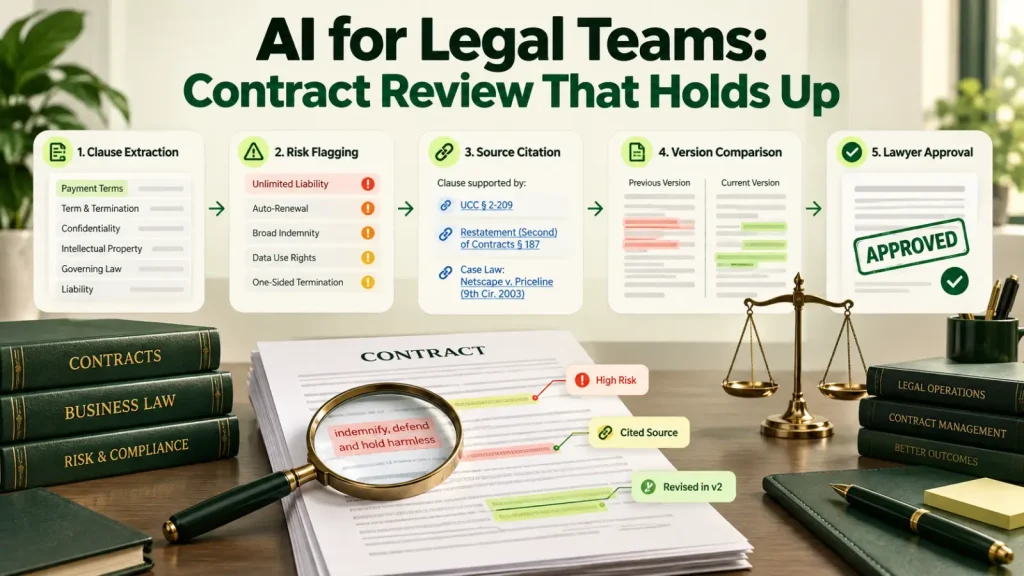
- Clause extraction. Pulling parties, term, renewal, notice periods, liability caps, governing law and assignment provisions into a searchable register. In effect, it turns a filing cabinet into a database.
- Deviation detection. Comparing an incoming draft against your standard positions and flagging every departure with the text quoted. In practice, this is the highest-value single application for most in-house teams.
- Discovery triage. Ranking documents by relevance so review effort goes where it matters, under supervision and with sampling to validate.
- Matter intake. Classifying and routing inbound requests, gathering the facts needed before a lawyer opens the file.
- Obligation tracking. Extracting dated commitments from executed contracts into a calendar, which is dull, valuable, and almost never done properly by hand.
Most teams should start with one of the first two. Clause extraction and deviation detection both have clear right answers, so you can measure accuracy before anyone relies on the output.
The controls that make it defensible
-
Every AI contract review flag carries a citation
A flagged clause must link to the exact text it came from. Therefore, a reviewer should never have to take the system’s word for anything, and an uncited assertion should be treated as unverified.
-
Privilege boundaries enforced in retrieval
The system must exclude privileged material at the retrieval layer by matter and access right, not filter it out afterwards. Post-hoc filtering is not a control.
-
Confidentiality terms verified
Client material requires contractual assurance of no training and defined retention. This is a professional obligation, not a preference.
-
Sampling to validate recall
Have a lawyer review a random sample of what the system did not flag. Precision is easy to check and recall is what actually matters, so measure the thing that is hard to see.
-
A named accountable lawyer
For every output that leaves the team. The system drafts and flags; a person is responsible. We also cover this pattern in more depth in our guide to human-in-the-loop AI design.
A worked example: a vendor contract backlog
Consider a hypothetical in-house team that needs to check 400 vendor contracts for liability caps and auto-renewal terms before a budget review. If each contract takes a lawyer about thirty minutes to read for those points, the backlog represents roughly 200 hours of attorney time.
With AI contract review scoped as triage, the system first extracts the cap, the renewal clause and the notice period from every contract, quoting the source text. Then it flags the contracts that depart from the team’s standard positions. Lawyers read the flagged set in full and also check a random sample of the unflagged set to confirm recall. As a result, attorney time goes to the contracts that actually need judgment. In addition, the team ends up with a searchable register it can reuse at the next renewal cycle.
These figures are illustrative, not a promise of what AI contract review will save. Real savings still depend on how varied the contracts are and how much of the library is scanned paper.
How we approach an AI contract review project
- Write down the playbook. First, we capture your standard and fallback positions for each clause type, because without a written playbook, deviation detection has nothing to compare against.
- Build a checked sample. Next, your lawyers mark up a representative set of contracts. That sample then becomes the test set for every later change to prompts or models.
- Measure before anyone relies on it. We report precision and recall per field on the sample, so the team knows where the system is strong and where it needs closer review.
- Pilot with one team. Then one practice group uses it on live work, with the sampling control in place from the first day.
- Connect it to your document system. Finally, we integrate with your existing repository, so permissions follow matters and nobody uploads files to a side tool.
For the professional responsibility side, read the ABA’s first ethics guidance on lawyers’ use of AI tools (Formal Opinion 512, July 2024) alongside your own state bar’s guidance. That way, the scope of your AI contract review system reflects your obligations from the start, rather than after a committee raises them.
Pitfalls we see most often
- Measuring only precision. A system that flags little looks accurate. However, the clauses it misses are the real risk, so sample the unflagged set.
- Skipping the playbook. Without agreed standard positions, every flag becomes a debate instead of a decision.
- Ignoring scan quality. Poor scans reduce extraction accuracy, so run OCR checks before blaming the model.
- Letting the tool sit outside your systems. Copying documents into a separate tool breaks matter permissions and creates a second, unmanaged archive.
- Rolling out to everyone at once. Each practice group drafts differently, so widen one team at a time and re-check accuracy as you go.
Measuring whether AI contract review works
Before rollout, agree on what good looks like. For extraction, measure accuracy per field on your checked sample, because a single overall score hides weak fields. For deviation detection, count how many real departures the system catches, as well as how many false flags lawyers must clear. Then repeat the same measurement whenever a prompt, model or playbook changes.
In addition, track time to first review on incoming drafts. When AI contract review is working, lawyers open each draft with the deviations already marked and quoted, so turnaround drops without anyone cutting corners. However, if lawyers still re-read every contract in full, treat that as a signal. Often it means they do not yet trust the flags, so the fix is better sampling evidence rather than more features.
Frequently asked questions
Is using AI for contract review an ethics problem?
How accurate is clause extraction?
Can we use this with client confidential material?
What does a legal AI project cost?
Will this replace our paralegals?
For implementation support, explore our legal AI solutions or discuss your workflow in a free consultation.